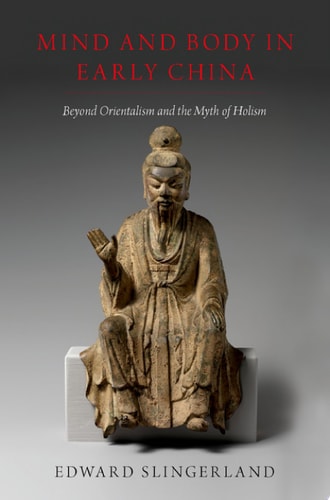
Mind and Body in Early China: Beyond Orientalism and the Myth of Holism
0
0
As an Amazon Associate and affiliate partner, Menrva Books earns from qualifying purchases. Learn more
Author Description
Mind and Body in Early China critiques Orientalist accounts of early China as the radical, "holistic" other. The idea that the early Chinese held the "strong" holist view, seeing no qualitative difference between mind and body, has long been contradicted by traditional archeological and qualitative textual evidence. New digital humanities methods, along with basic knowledge about human cognition, now make this position untenable. A large body of empirical evidence suggests that "weak" mind-body dualism is a psychological universal, and that human sociality would be fundamentally impossible without it.Edward Slingerland argues that the humanities need to move beyond social constructivist views of culture, and embrace instead a view of human cognition and culture that integrates the sciences and the humanities. Our interpretation of texts and artifacts from the past and from other cultures should be constrained by what we know about the species-specific, embodied commonalities shared by all humans. This book also attempts to broaden the scope of humanistic methodologies by employing team-based qualitative coding and computer-aided "distant reading" of texts, while also drawing upon our current best understanding of human cognition to transform our basic starting point. It has implications for anyone interested in comparative religion, early China, cultural studies, digital humanities, or science-humanities integration.
Menrva's Summary
THE THESIS
This book investigates whether the early Chinese philosophical tradition truly lacked a distinction between mind and body, challenging the prevailing academic narrative of radical holism. Edward Slingerland, a scholar of early Chinese thought, utilizes a combination of traditional textual analysis and modern digital humanities methodologies to argue that mind-body dualism is a psychological universal. By integrating cognitive science with humanistic inquiry, the author contends that human sociality necessitates a cognitive separation between mental and physical states, regardless of cultural context.
THE SCOPE MAP
What You Will Find
- Analysis of early Chinese philosophical texts and archaeological artifacts.
- Application of team-based qualitative coding and computer-aided distant reading.
- Integration of empirical cognitive science research with historical textual interpretation.
Scope Limits
- The study focuses primarily on early Chinese intellectual history and does not provide an exhaustive survey of all subsequent Chinese philosophical developments.
- It does not attempt to resolve all debates within the field of comparative religion.
THE AUTHORITY PERSPECTIVE
Scholars and researchers in the humanities frequently cite this work as a significant methodological intervention that bridges the gap between traditional philology and the cognitive sciences. Experts highlight the text as a rigorous challenge to long-standing Orientalist tropes, noting its utility for those interested in the intersection of digital humanities and historical inquiry.
Page Count:
399
Publication Date:
2018-01-01
Publisher:
Oxford University Press
ISBN-10:
0190842326
ISBN-13:
9780190842321
History
Philosophy
Religion
Mind & Body
Buddhism
Eastern
Special Topics
Holism
Sinology
Community Tags
Similar Books