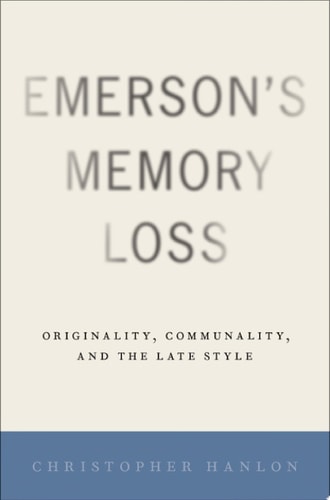
Emerson's Memory Loss
0
0
As an Amazon Associate and affiliate partner, Menrva Books earns from qualifying purchases. Learn more
Author Description
Ralph Waldo Emerson's Dementia, An Ordeal That Marked His Final Two Decades, Has Never Been A Secret Among Those Who Study Emerson's Life. Still, Few Have Focused On The Period Of Emerson's Decline. Thus, His Later Thinking Has Succumbed To A Process Of Critical Forgetting Too Often Ignored By Scholars If Not Excluded From His Oeuvre Altogether. And Yet Emerson's Late Output, Composed As His Patterns Of Cognition Transformed Profoundly, Stages A Reconsideration Of Interests That Had Preoccupied Him For Decades: The Continuum Of Human Thought And The Rest Of Nature, The Bearing Of The Individual Toward The Collective, The Mind's Relationship With The Body. Emerson's Memory Loss Presents An Archive Of Texts Documenting Emerson's Intellectual, Affective, And Associative States During His Late Phase, Along With The Varying Forms Of Shared Connection From Which These Works Emerge. It Is Also About The Way Such Texts Connect Emerson With A Stream Of Thought In America, Coursing Through The Works Of Other Nineteenth-century Writers And Thinkers Adjacent To Emerson, That Emphasizes The Aggregate Over The Singular, The Social Over The Solipsistic, The Engaged Over The Distant, And The Many Over The One. Hanlon Attends To Manuscripts And Publications Marking Emerson's Collaborations With Others Which Emerson Himself Articulated As His Most Important Work-texts Written Even As His Ability To Do So Independently Waned. Hanlon Measures Its Resonance Across Broader Strains Of U.s. Culture Familiar To Margaret Fuller, Herman Melville, Walt Whitman, And More.
Menrva's Summary
THE THESIS
This book investigates how Ralph Waldo Emerson’s late-life cognitive decline influenced his philosophical output and challenged traditional scholarly interpretations of his work. Christopher Hanlon, a scholar of nineteenth-century American literature, utilizes archival manuscripts and published texts from Emerson’s final two decades to argue that his late-stage cognitive transformation did not diminish his intellectual relevance. Instead, Hanlon posits that these works reveal a shift toward collaborative thought and social engagement that has been largely overlooked by previous academic analysis.
THE SCOPE MAP
What You Will Find
- Analysis of Emerson’s late-period manuscripts and collaborative writing projects.
- Examination of the intellectual connections between Emerson and contemporaries like Margaret Fuller, Herman Melville, and Walt Whitman.
- A framework for understanding the shift from individualistic philosophy to collective, aggregate thought in nineteenth-century American culture.
Scope Limits
- The text does not provide a comprehensive clinical medical history of Emerson’s condition.
- It does not attempt to cover Emerson’s early or middle-period philosophical development in detail.
THE AUTHORITY PERSPECTIVE
Scholars recognize this work as a significant intervention in Emersonian studies, specifically for its focus on the neglected final decades of his career. Experts note the text's academic rigor and its contribution to re-evaluating the relationship between cognitive health and philosophical production.
Page Count:
288
Publication Date:
2017-01-01
Publisher:
Oxford University Press
ISBN-10:
0190842539
ISBN-13:
9780190842536
Philosophy
Biography
History
Literary Criticism
American
19th Century
Community Tags
Similar Books