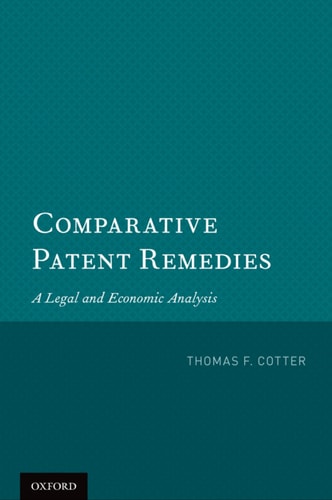
Comparative Patent Remedies: A Legal and Economic Analysis
0
0
As an Amazon Associate and affiliate partner, Menrva Books earns from qualifying purchases. Learn more
Author Description
Nations throughout the world receive more patent applications, grant more patents, and entertain more patent infringement lawsuits than ever before. To understand the contemporary patent system, it is crucial to become familiar with how courts and other actors in different countries enable patent owners to enforce their rights. This is increasingly important, not only for firms that seek to market their products worldwide and for the lawyers who provide them with counsel, but also for scholars and policymakers working to develop better policies for promoting the innovation that drives long-term economic growth. Comparative Patent Remedies provides a critical and comparative analysis of patent enforcement in the United States and other major patent systems, including the European Union, Japan, Canada, Australia, China, South Korea, Taiwan, and India. Thomas Cotter shows how different countries respond to similar issues, and suggests how economic analysis can assist in adapting current practice to the needs of the modern world. Among the topics addressed are: how courts in various nations award monetary compensation for patent infringement, including lost profits, infringer's profits, and reasonable royalties; the conditions under which patent owners may obtain preliminary and permanent injunctions, including cross-border injunctions in the European Union; the availability of various options for potential defendants to challenge patent validity; and other matters, such as the availability of criminal enforcement and border measures to exclude infringing goods.
Menrva's Summary
THE THESIS
This book investigates how different national legal systems address patent infringement remedies and whether economic analysis can optimize these enforcement mechanisms for global innovation. Thomas F. Cotter, a professor of law, utilizes a comparative legal framework to evaluate how various jurisdictions balance the rights of patent holders against the needs of the broader economy. By synthesizing legal statutes and economic theory, the author provides a structured approach to understanding the divergence in how countries handle monetary damages and injunctive relief.
THE SCOPE MAP
What You Will Find
- Comparative analysis of patent enforcement in the US, EU, Japan, Canada, Australia, China, South Korea, Taiwan, and India.
- Examination of monetary compensation models including lost profits and reasonable royalties.
- Analysis of the conditions for preliminary and permanent injunctions.
- Discussion of criminal enforcement and border measures for infringing goods.
Scope Limits
- The text does not provide a comprehensive guide to patent prosecution or filing procedures.
- It does not offer specific legal advice for individual litigation cases.
THE AUTHORITY PERSPECTIVE
Legal scholars and practitioners frequently cite this work as a primary resource for understanding the intersection of international patent law and economic policy. Experts highlight the text for its rigorous comparative methodology and its utility in informing policy debates regarding global innovation standards.
Page Count:
470
Publication Date:
2013-01-01
Publisher:
Oxford University Press
ISBN-10:
0190842903
ISBN-13:
9780190842901
Economics
Intellectual Property
Law
Comparative Law
Patent Law
Professional Career & Trade
International Law
Community Tags
Similar Books