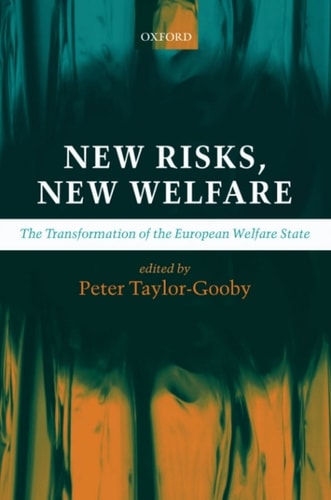
New Risks, New Welfare: The Transformation of the European Welfare State
0
0
As an Amazon Associate and affiliate partner, Menrva Books earns from qualifying purchases. Learn more
Author Description
This book introduces the concept of new social risks in welfare state studies and explains their relevance to the comparative understanding of social policy in Europe. New social risks arise from shifts in the balance of work and family life as a direct result of the declining importance of the male breadwinner family, changes in the labour market, and the impact of globalization on national policy-making. They differ from the old social risks of the standard industrial life-course, which were concerned primarily with interruptions to income from sickness, unemployment, retirement, and similar issues. New social risks pose new challenges for the welfare policies of European countries, such as the care of children and the elderly, more equal opportunities, the activation of labour markets and the management of needs that arise from welfare state reform, and new opportunities for the coordination of policies at the EU level. The book includes detailed and up-to-date case studies of policy development across these areas in the major European countries. These studies, written by leading experts, are organized in a comparative framework which is followed throughout the book. They highlight the way in which national welfare state regimes and institutional arrangements shape policy-making to meet new social risks. A major feature of this volume is the analysis of developments at the EU level and their interaction with national policies. The EU has been largely unsuccessful in its interventions in old social risk policy, but appears to have more success in its attempts to coordinate policy for new social risks. Experience here may provide lessons for future developments in EU policy-making. The comparative framework of the book seeks to inform an understanding of the development of new social risks in Europe and of the particular political opportunities and challenges that result. It provides an original analysis of pressing issues at the forefront of European welfare polic
Menrva's Summary
THE THESIS
This book investigates how the emergence of 'new social risks' necessitates a fundamental transformation in the structure and function of European welfare states. Author Peter Taylor-Gooby, a prominent scholar in social policy, synthesizes contributions from leading experts to argue that traditional industrial-era welfare models are increasingly inadequate. By examining the decline of the male breadwinner model and the pressures of globalization, the text establishes a framework for understanding how national and EU-level policies must adapt to contemporary demographic and labor market shifts.
THE SCOPE MAP
What You Will Find
- Comparative analysis of welfare state regimes across major European nations.
- Examination of policy responses to child care, elder care, and labor market activation.
- Analysis of the interaction between national policy-making and EU-level coordination.
Scope Limits
- The text does not provide an exhaustive history of all European social programs.
- It does not focus on the 'old social risks' of traditional sickness or retirement income protection, except as a point of contrast.
THE AUTHORITY PERSPECTIVE
Experts recognize this volume as a foundational text for understanding the shift from industrial-era social security to modern risk management in Europe. Readers frequently note the academic density of the prose and the utility of its comparative framework for students of public policy.
Page Count:
262
Publication Date:
2005-01-01
Publisher:
Oxford University Press
ISBN-10:
0191533033
ISBN-13:
9780191533037
Economics
Social change
Public Administration
Social policy
Public Policy
Sociology
Community Tags
Other Editions(2)

Similar Books












Reader Comments
Share Your Thoughts
No comments yet. Be the first to share your thoughts!