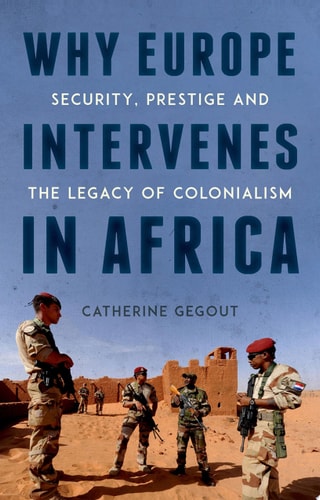
Why Europe Intervenes in Africa: Security, Prestige and the Legacy of Colonialism
0
0
As an Amazon Associate and affiliate partner, Menrva Books earns from qualifying purchases. Learn more
Author Description
Why Europe Intervenes in Africa analyses the underlying causes of all European decisions for and against military interventions in conflicts in African states since the late 1980s. It focuses on the main European actors who have deployed troops in Africa: France, the United Kingdom and the European Union.When conflict occurs in Africa, the response of European actors is generally inaction. This can be explained in several ways: the absence of strategic and economic interests, the unwillingness of European leaders to become involved in conflicts in former colonies of other European states, and sometimes the Eurocentric assumption that conflict in Africa is a normal event which does not require intervention. When European actors do decide to intervene, it is primarily for motives of security and prestige, and not primarily for economic or humanitarian reasons. The weight of past relations with Africa can also be a driver for European military intervention, but the impact of that past is changing.This book offers a theory of European intervention based mainly on realist and post-colonial approaches. It refutes the assumptions of liberals and constructivists who posit that states and organisations intervene primarily in order to respect the principle of the 'responsibility to protect'.
Menrva's Summary
THE THESIS
This book investigates the underlying motivations behind European military interventions in African conflicts since the late 1980s, challenging the narrative that humanitarian concerns are the primary drivers. Catherine Gegout, a scholar in international relations, utilizes a realist and post-colonial framework to analyze decision-making processes within France, the United Kingdom, and the European Union. By examining specific instances of intervention and inaction, the author argues that security interests and national prestige, rather than economic gain or the 'responsibility to protect,' dictate European military engagement in Africa.
THE SCOPE MAP
What You Will Find
- Comparative analysis of military interventions by France, the UK, and the EU.
- Theoretical framework blending realism and post-colonial theory.
- Examination of the transition from colonial-era influence to modern security policy.
Scope Limits
- Does not provide a comprehensive history of all African conflicts during the period.
- Excludes non-European actors involved in African security operations.
THE AUTHORITY PERSPECTIVE
Scholars and political analysts recognize this work as a rigorous critique of European foreign policy, noting its departure from liberal interpretations of international intervention. The text is frequently cited for its clear application of realist theory to contemporary geopolitical events in Africa.
Page Count:
320
Publication Date:
2018-01-01
Publisher:
Oxford University Press
ISBN-10:
0190845163
ISBN-13:
9780190845162
Military History
International relations
Europe
Africa - History
Community Tags
Similar Books