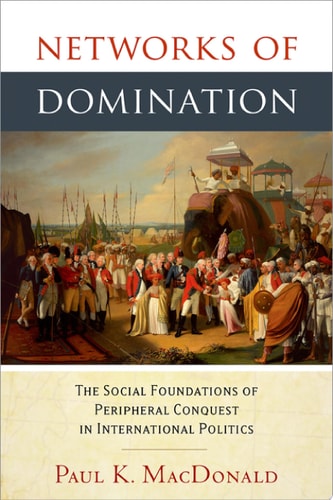
Networks of Domination: The Social Foundations of Peripheral Conquest in International Politics
0
0
As an Amazon Associate and affiliate partner, Menrva Books earns from qualifying purchases. Learn more
Author Description
In the nineteenth century, European states conquered vast stretches of territory across the periphery of the international system. Much of Asia and Africa fell to the armies of the European great powers, and by World War I, those armies controlled 40 percent of the world's territory and 30 percent of its population. Conventional wisdom states that these conquests were the product of European military dominance or technological superiority, but the reality was far more complex.In Networks of Domination, Paul MacDonald argues that an ability to exploit the internal political situation within a targeted territory, not mere military might, was a crucial element of conquest. European states enjoyed greatest success when they were able to recruit local collaborators from within the society and exploit divisions among elites. Different configurations of social ties connecting potential conquerors with elites were central to both the patterns of imperial conquest and the strategies conquerors employed. MacDonald compares episodes of British colonial expansion in India, South Africa, and Nigeria during the nineteenth century, and also examines the contemporary applicability of the theory through an examination of the United States occupation of Iraq.The scramble for empire fundamentally shaped, and continues to shape, the international system we inhabit today. Featuring a powerful theory of the role of social networks in shaping the international system, Networks of Domination bridges past and present to highlight the lessons of conquest.
Menrva's Summary
THE THESIS
This book investigates why European powers were able to successfully conquer vast territories in the nineteenth century, challenging the conventional focus on military and technological superiority. Paul MacDonald, a scholar of international politics, argues that the true mechanism of imperial expansion was the ability to exploit internal social divisions and recruit local collaborators within targeted societies. By analyzing the configurations of social ties between conquerors and local elites, the author provides a framework for understanding how peripheral conquest was achieved and sustained. The work extends this theory to modern contexts, specifically evaluating the United States occupation of Iraq to demonstrate the enduring relevance of these social network dynamics.
THE SCOPE MAP
What You Will Find
- Comparative analysis of British colonial expansion in India, South Africa, and Nigeria during the nineteenth century.
- A theoretical framework centered on the role of social networks and elite collaboration in imperial success.
- Examination of the contemporary application of imperial theory through the lens of the United States occupation of Iraq.
- Historical data regarding the extent of European territorial control prior to World War I.
THE AUTHORITY PERSPECTIVE
Experts in international relations and history recognize this work as a significant contribution to the study of imperial strategy and state-building. Readers frequently note the academic density of the prose and the rigor with which the author applies his social network theory to both historical and modern case studies.
Page Count:
336
Publication Date:
2014-06-12
Publisher:
Oxford University Press
ISBN-10:
0199362165
ISBN-13:
9780199362165
Politics
History
Military History
Balance of power
Kindle Store
Specific Topics
Kindle eBooks
Categories
Colonialism
Europe
World politics
International relations
Community Tags
Similar Books