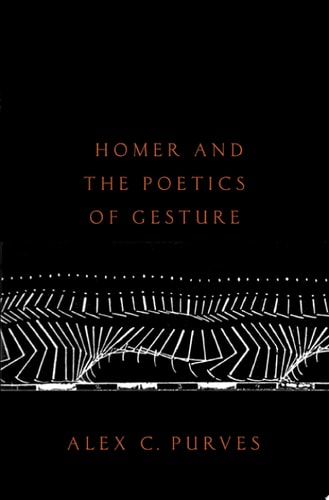
Homer and the Poetics of Gesture
0
0
As an Amazon Associate and affiliate partner, Menrva Books earns from qualifying purchases. Learn more
Author Description
Homer and the Poetics of Gesture is the first book of its kind to consider the epic formula in terms that are gestural as well as verbal. Drawing on studies from multiple disciplines, including movement theory, dance studies, phenomenology, and early film, it suggests new approaches for interpreting the relationship between repetition and embodiment in Homer. Through a series of dynamic close readings, Purves argues that the deep-seated habits and gestures of epic bodies are instrumental to our understanding of the Iliad and Odyssey, especially insofar as they attune us to the kinetic structures and sensibilities that shape the meaning of the poems. Each of the chapters isolates a scene in which a specific action, posture, or gesture (falling, running, leaping, standing, and reaching) emerges from the background of its other iterations in order to make larger claims about its poetic significance within the epics as a whole. Beginning from the premise that gestures are shared between characters and often identically repeated within the poems' formulaic system, the book reconsiders long-standing arguments about Homeric agency and character by focusing on those moments when a gesture diverges from its expected course, redirecting the plot or drawing the poem in new and surprising directions. Homer and the Poetics of Gesture not only affords new insights into the nature of epic repetition and poetic originality but also reveals unnoticed connections between Homeric structure and technique and the embodied habits and movements of the characters within the poems.
Menrva's Summary
THE THESIS
This book investigates how the epic formulas of the Iliad and Odyssey function as gestural patterns rather than purely verbal repetitions. Alex C. Purves, a scholar of classical literature, utilizes an interdisciplinary framework that integrates movement theory, dance studies, and phenomenology to analyze the physical actions of Homeric characters. The central argument posits that the repetitive gestures within the epics are not merely stylistic markers but are essential components that shape narrative meaning and character agency.
THE SCOPE MAP
What You Will Find
- Analysis of specific physical actions including falling, running, leaping, standing, and reaching.
- A methodology that bridges classical philology with contemporary movement and film theory.
- Close readings of key scenes from the Iliad and the Odyssey to demonstrate how gestural divergence impacts plot progression.
Scope Limits
- The study focuses primarily on the physical and kinetic aspects of the poems rather than historical or archaeological context.
- It does not provide a comprehensive survey of all Homeric scholarship but focuses specifically on the intersection of repetition and embodiment.
THE AUTHORITY PERSPECTIVE
Scholars and classicists recognize this work as a distinct contribution to Homeric studies for its focus on the physical body in epic poetry. Readers frequently note that the text requires a familiarity with classical scholarship but offers a unique, theoretically informed lens for analyzing traditional epic structures.
Page Count:
228
Publication Date:
2018-01-01
Publisher:
Oxford University Press
ISBN-10:
0190857943
ISBN-13:
9780190857943
Philosophy
Literary Criticism
Poetics
Movement Theory
History & Surveys
Criticism and interpretationHomer
English & College Success
Phenomenology
English
Homer
Community Tags
Similar Books