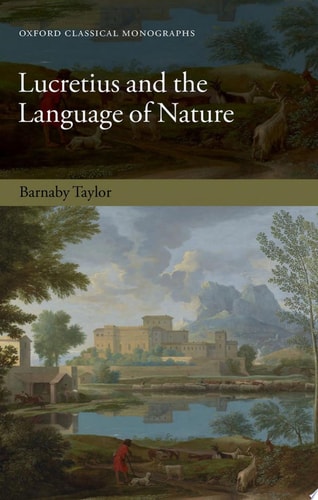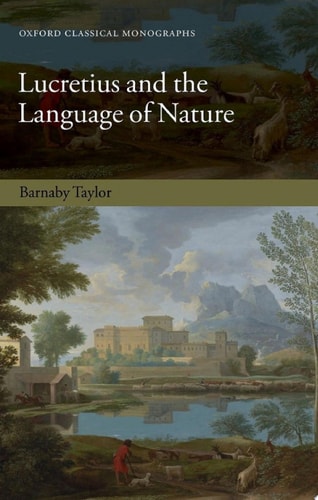
Lucretius and the Language of Nature
0
0
As an Amazon Associate and affiliate partner, Menrva Books earns from qualifying purchases. Learn more
Author Description
Lucretius' Epicurean poem De Rerum Natura ('On the Nature of Things'), written in the middle of the first century BC, made a fundamental and lasting contribution to the language of Latin philosophy. The style of De Rerum Natura is like nothing else in extant Latin: at once archaic and modern, Romanizing and Hellenizing, intimate and sublime, it draws on multiple literary genres and linguistic registers. This book offers a study of Lucretius' linguistic innovation and creativity. Lucretius is depicted as a linguistic trailblazer, extending and augmenting the technical language of Latin in order to describe the Epicurean universe of atoms and void in all its complexity and sublimity. A detailed understanding of the Epicurean linguistic theory brings with it a greater appreciation of Lucretius' own language. Accordingly, this book features an in-depth reconstruction of certain core features of Epicurean linguistic theory. Elements of Lucretius' style discussed include his attitudes to, and use of, figurative language (especially metaphor); his explorations, both explicit and implicit, of Latin etymology; his uses of Greek; and his creative deployment of compounds and prefixed words. His practice is related throughout not only to the underlying Epicurean theory but also to contemporary Roman attitudes to style and language. The result is a new reading of one of the greatest and most difficult works to survive from the Roman world.
Menrva's Summary
THE THESIS
This work investigates how Lucretius expanded the boundaries of the Latin language to articulate the complex tenets of Epicurean philosophy. Barnaby Taylor, a scholar of classical literature, examines the intersection of linguistic theory and poetic practice in De Rerum Natura. By reconstructing Epicurean views on language, the author argues that Lucretius functioned as a deliberate innovator who synthesized archaic and modern registers to map the physical universe of atoms and void.
THE SCOPE MAP
What You Will Find
- Analysis of Lucretius' use of metaphor and figurative language
- Examination of Latin etymology and the integration of Greek terminology
- Study of morphological innovations including compound and prefixed words
- Reconstruction of Epicurean linguistic theory
Scope Limits
- The text does not provide a general history of Roman literature
- It does not offer a comprehensive biography of Lucretius beyond his linguistic output
THE AUTHORITY PERSPECTIVE
Scholars recognize this monograph as a rigorous contribution to the study of Latin philosophical prose and the technical challenges of translating Epicurean thought. The text is noted for its academic density and is primarily intended for researchers and students of classical philology.
Page Count:
235
Publication Date:
2020-01-01
Publisher:
OUP Oxford
ISBN-10:
0191071072
ISBN-13:
9780191071072
Philosophy
Linguistics
Latin
English & College Success
English
Ancient History
Literary Criticism