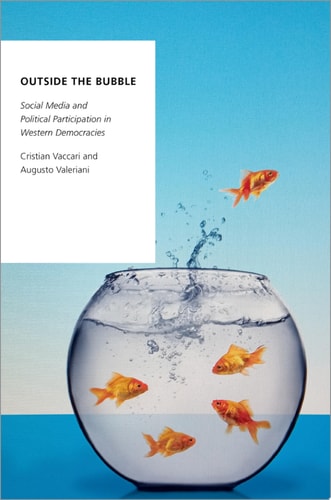
Outside the Bubble: Social Media and Political Participation in Western Democracies
0
0
As an Amazon Associate and affiliate partner, Menrva Books earns from qualifying purchases. Learn more
Author Description
Much time has been spent over the past decade debating whether social media contribute to democracy. Drawing on an original study of internet users across nine Western democracies, Outside the Bubble offers an unprecedented look at the effects of social media on democratic participation. This book argues that social media do indeed increase political participation in both online and face-to-face activities--and that they expand political equality across Western democracies. In fact, Cristian Vaccari and Augusto Valeriani find that, for the most part, social media do not constitute echo chambers or filter bubbles as most users see a mixture of political content they agree and disagree with. Various political experiences on social media have positive implications for participation and active political involvement: social media allow citizens to encounter clearly identifiable political viewpoints, facilitate accidental exposure to political news, and enable political actors and ordinary citizens to reach voters with electoral messages designed to mobilize them. Moreover, political interactions occurring on social media do not only benefit citizens who are already involved, but boost participation across the board. This is because social media offer both additional participatory incentives to the already engaged and new political opportunities for the less engaged. By adopting a comparative approach, Vaccari and Valeriani also show that political institutions matter since some political experiences on social media are more strongly associated with participation in majoritarian systems and in party-centric systems. While social media may contribute to many societal problems, they can help address at least two important democratic ills: citizens' apathy towards politics, and inequalities between those who choose to exercise their voice and those who remain silent.
Menrva's Summary
THE THESIS
This book investigates whether social media platforms function as democratic tools that foster political participation or as echo chambers that deepen societal divisions. Authors Cristian Vaccari and Augusto Valeriani, both established scholars in political communication, utilize a comparative framework to analyze original data collected from internet users across nine Western democracies. They argue that social media platforms generally serve to increase political engagement and reduce inequalities by providing diverse political content and mobilizing both active and previously disengaged citizens.
THE SCOPE MAP
What You Will Find
- Comparative analysis of political behavior across nine distinct Western democratic systems.
- Empirical evidence regarding the prevalence of echo chambers and filter bubbles.
- Examination of the relationship between social media usage and both online and offline political activities.
- Assessment of how institutional structures, such as majoritarian or party-centric systems, influence digital political experiences.
Scope Limits
- The study focuses primarily on Western democracies and may not be generalizable to authoritarian or non-Western political contexts.
- The research does not provide an exhaustive analysis of all societal problems attributed to social media, focusing specifically on political apathy and participation.
THE AUTHORITY PERSPECTIVE
Experts in political science and digital media studies recognize this work as a significant empirical contribution to the debate on digital democracy. Readers frequently note that the authors provide a data-driven counter-narrative to the prevailing pessimism surrounding social media's impact on political discourse.
Page Count:
299
Publication Date:
2021-01-01
Publisher:
Oxford University Press
ISBN-10:
0190858508
ISBN-13:
9780190858506
Communication Studies
Comparative Politics
Democracy
Social Media
Sociology
Community Tags
Similar Books