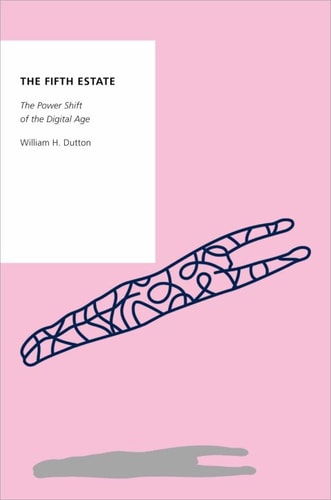
The Fifth Estate: The Power Shift of the Digital Age
0
0
As an Amazon Associate and affiliate partner, Menrva Books earns from qualifying purchases. Learn more
Author Description
In the eighteenth century, the printing press enabled the rise of an independent press--the Fourth Estate--that helped check the power of governments, business, and industry. In similar ways, the internet is forming a more independent collectivity of networked individuals, which William H. Dutton identifies as the Fifth Estate. Their network power is contributing to a more pluralist role of individuals in democratic political processes and society, which is not only shaping political accountability but nearly every sector of society. Yet a chorus of critics have dismissed the internet's more democratic potentials, demonizing social media and user-generated-content as simply sources of fake news and populism. So, is the internet a tool for democracy or anarchy? In The Fifth Estate, Dutton uses estate theory to illuminate the most important power shift of the digital age. He argues that this network power shift is not only enabling greater democratic accountability in politics and governance but is also empowering networked individuals in their everyday life and work, from checking facts to making civic-minded social interventions. By marshalling world leading research and case studies in a wide range of contexts, Dutton demonstrates that the internet and related digital media are enabling ordinary individuals to search, create, network, collaborate, and leak information in such independent and strategic ways that they enhance their informational and communicative power vis-à-vis other actors and institutions. Dutton also makes the case that internet policy interventions across the globe have increased censorship of users and introduced levels of surveillance that will challenge the vitality of the internet and the Fifth Estate, along with its more pluralist distribution of power. Ambitious and timely, Dutton provides an understanding of the Fifth Estate and its democratic potential so that networked individuals and institutions around the world can maintain and enhan
Menrva's Summary
THE THESIS
Does the rise of the internet as a 'Fifth Estate' fundamentally shift power dynamics toward individual agency, or does it merely facilitate anarchy and misinformation? William H. Dutton, a prominent scholar in internet studies, utilizes estate theory to analyze how networked individuals are challenging traditional institutional power. He argues that digital tools provide citizens with unprecedented capabilities to collaborate, verify information, and hold governance structures accountable, despite the concurrent rise of state-sponsored surveillance and censorship.
THE SCOPE MAP
What You Will Find
- A theoretical framework applying the concept of the 'Fifth Estate' to digital network power.
- Analysis of how individuals utilize digital media to influence political and social accountability.
- Case studies examining the intersection of internet policy, censorship, and user-generated content.
Scope Limits
- The text does not provide a comprehensive technical manual for digital security or specific software implementation.
- It focuses primarily on political and social power dynamics rather than the economic mechanics of digital markets.
THE AUTHORITY PERSPECTIVE
Experts recognize this work as a significant contribution to the study of digital politics, noting its clear theoretical grounding in historical estate models. Readers frequently highlight the academic rigor of the research, which serves as a foundational text for understanding the tension between democratic potential and institutional control in the digital era.
Page Count:
283
Publication Date:
2023-01-01
Publisher:
Oxford University Press
ISBN-10:
0190688394
ISBN-13:
9780190688394
Comparative Politics
Communications
Technology and Society
Digital Media
Sociology
Communication Studies
Introduction to Human Communication
Community Tags
Other Editions(2)
Similar Books



Reader Comments
Share Your Thoughts
No comments yet. Be the first to share your thoughts!