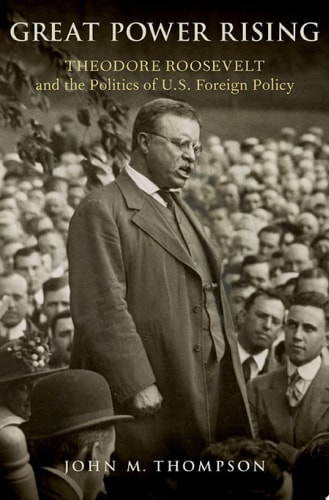
Great Power Rising: Theodore Roosevelt and the Politics of U.S. Foreign Policy
0
0
As an Amazon Associate and affiliate partner, Menrva Books earns from qualifying purchases. Learn more
Author Description
The nature of the US political system, with its overlapping powers, intense partisanship, and continuous scrutiny from the media and public, complicates the conduct of foreign policy. While numerous presidents have struggled under the weight of these conditions, Theodore Roosevelt thrived and is widely lauded for his diplomacy. Roosevelt played a crucial role in the nation's rise to world power, competition with other new Great Powers such as Germany and Japan, and US participation in World War I. He was able to implement the majority of his agenda even though he was confronted by a hostile Democratic Party, suspicious conservatives in the Republican Party, and the social and political ferment of the progressive era. The president, John M. Thompson argues, combined a compelling vision for national greatness, considerable political skill, faith in the people and the US system, and an emphasis on providing leadership. It helped that the public mood was not isolationist, but was willing to support all of his major objectives-though Roosevelt's feel for the national mood was crucial, as was his willingness to compromise when necessary. This book traces the reactions of Americans to the chief foreign policy events of the era and the ways in which Roosevelt responded to and sought to shape his political environment.Offering the first analysis of the politics of foreign policy for the entirety of Roosevelt's career, Great Power Rising sheds new light on the twenty-sixth president and the nation's emergence as a preeminent player in international affairs.
Menrva's Summary
THE THESIS
This book investigates how Theodore Roosevelt successfully navigated the complex, partisan American political landscape to establish the United States as a preeminent global power. John M. Thompson, an expert in political history, utilizes archival records and historical analysis to argue that Roosevelt’s success stemmed from a unique combination of visionary leadership, political pragmatism, and an acute ability to align his foreign policy agenda with the shifting national mood. The work examines how Roosevelt managed opposition from both Democratic rivals and conservative Republicans to implement his international objectives during a period of significant social and political transition.
THE SCOPE MAP
What You Will Find
- A comprehensive analysis of U.S. foreign policy throughout the entirety of Theodore Roosevelt's career.
- Examination of the interaction between domestic political constraints and international diplomacy.
- Case studies on the rise of U.S. power in competition with Germany and Japan.
- Analysis of public opinion and media influence on presidential decision-making.
Scope Limits
- The text focuses primarily on the political mechanics of foreign policy rather than a full biographical account of Roosevelt's personal life.
- It does not provide an exhaustive military history of the era, focusing instead on the political and diplomatic dimensions.
THE AUTHORITY PERSPECTIVE
Historians and political scientists recognize this work as a significant contribution to the study of the American presidency and the evolution of U.S. foreign policy. Readers frequently note the academic rigor of the prose and the author's ability to synthesize complex political dynamics into a coherent historical narrative.
Page Count:
288
Publication Date:
2019-01-01
Publisher:
Oxford University Press
ISBN-10:
0190859970
ISBN-13:
9780190859978
Biography
History
American History
Diplomatic History
Special Topics
International relations
Political Leadership
Community Tags
Similar Books