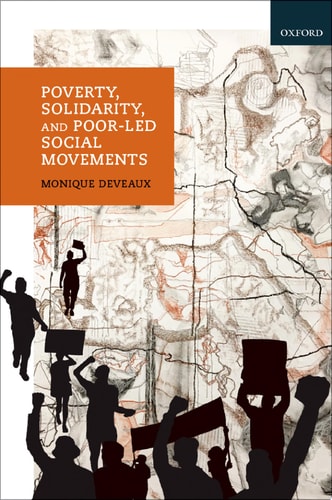
Poverty, Solidarity, and Poor-Led Social Movements
0
0
As an Amazon Associate and affiliate partner, Menrva Books earns from qualifying purchases. Learn more
Author Description
This is an open access title available under the terms of a [CC BY-NC-ND 4.0 International] license. It is free to read at [Oxford Scholarship Online] and offered as a free PDF download from OUP and selected open access locations. Poverty is not only about material deprivation, but also about the subordination and disempowerment of poor populations. So why isn't the emancipation and empowerment of the poor a core goal of ethical arguments for poverty reduction? Deveaux argues in this book that philosophers fail to prioritize these ends, and to recognize the moral and political agency of poor people, because they still conceive of poverty narrowly and apolitically as mere needs scarcity. By comparison, poor activists and critical poverty researchers who see deprivation as structural exclusion and powerlessness advocate a "poor-centered," poor-led, approach to reducing poverty. Stuck in an older paradigm of poverty thinking, philosophers have failed to recognize the power and moral authority of poor communities--and their movements for justice and social change. If normative ethicists seek to contribute to proposals for just and durable poverty reduction, they will need to look to the insights and aims of "pro-poor," poor-led social movements. From rural landless workers in Brazil, to urban shack dwellers in South Africa, to unemployed workers impoverished by neoliberal economic policies in Argentina, poor-led organizations and movements advance a more political understanding of poverty--and of what is needed to eradicate it. Deveaux shows how these groups develop the political consciousness and collective capabilities of poor communities and help to create the basis for solidarity among poor populations. Defending the idea of a political responsibility for solidarity, she shows how nonpoor outsiders--individuals, institutions, and states--can help to advance a transformative anti-poverty agenda by supporting the efforts of these movements.
Menrva's Summary
THE THESIS
This book investigates why contemporary ethical arguments for poverty reduction frequently overlook the agency and political leadership of poor populations. Monique Deveaux, a professor of philosophy, critiques the prevailing academic paradigm that treats poverty primarily as a scarcity of resources rather than a consequence of structural exclusion. She argues that normative ethicists must shift their focus toward the strategies and moral authority of poor-led social movements to develop more effective and just solutions for poverty eradication.
THE SCOPE MAP
What You Will Find
- A critique of traditional philosophical approaches to poverty and needs-based ethics.
- An analysis of the political consciousness and collective capabilities developed by grassroots organizations.
- A framework for understanding the moral responsibility of non-poor actors to support poor-led movements.
- Case studies of movements including landless workers in Brazil, shack dwellers in South Africa, and unemployed workers in Argentina.
Scope Limits
- The text does not provide a comprehensive economic policy manual for poverty reduction.
- It does not focus on individual-level charitable interventions, prioritizing structural and political change instead.
THE AUTHORITY PERSPECTIVE
Scholars in political philosophy and social ethics view this work as a significant challenge to traditional, top-down approaches in poverty discourse. Readers frequently note the academic rigor of the text and its success in bridging the gap between abstract normative theory and the practical realities of global social movements.
Page Count:
279
Publication Date:
2021-01-01
Publisher:
Oxford University Press
ISBN-10:
0190850302
ISBN-13:
9780190850302
Philosophy
Political Philosophy
Poor
Social justice
Solidarity
Ethics
Poverty
Sociology
Community Tags
Similar Books