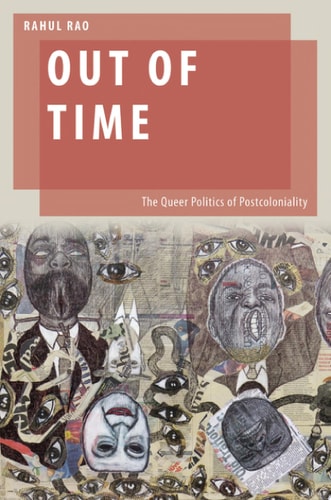
Out of Time: The Queer Politics of Postcoloniality
0
0
As an Amazon Associate and affiliate partner, Menrva Books earns from qualifying purchases. Learn more
Author Description
Between 2009 and 2014, an anti-homosexuality law circulating in the Ugandan parliament came to be the focus of a global conversation about queer rights. The law attracted attention for the draconian nature of its provisions and for the involvement of US evangelical Christian activists who were said to have lobbied for its passage. Focusing on the Ugandan case, this book seeks to understand the encounters and entanglements across geopolitical divides that produce and contest contemporary queerphobias. It investigates the impact and memory of the colonial encounter on the politics of sexuality, the politics of religiosity of different Christian denominations, and the political economy of contemporary homophobic moral panics.In addition, Out of Time places the Ugandan experience in conversation with contemporaneous developments in India and Britain--three locations that are yoked together by the experience of British imperialism and its afterlives. Intervening in a queer theoretical literature on temporality, Rahul Rao argues that time and space matter differently in the queer politics of postcolonial countries. By employing an intersectional analysis and drawing on a range of sources, Rao offers an original interpretation of why queerness mutates to become a metonym for categories such as nationality, religiosity, race, class, and caste. The book argues that these mutations reveal the deep grammars forged in the violence that founds and reproduces the social institutions in which queer difference struggles to make space for itself.
Menrva's Summary
THE THESIS
This book investigates how the intersection of postcoloniality, religion, and global politics shapes contemporary queerphobias across different geopolitical contexts. Rahul Rao, a scholar of international relations and political theory, utilizes the Ugandan anti-homosexuality law as a primary case study to analyze the lingering effects of British imperialism. By comparing experiences in Uganda, India, and Britain, the author argues that queer politics in postcolonial nations are uniquely influenced by historical violence and the specific social institutions that reproduce these power dynamics.
THE SCOPE MAP
What You Will Find
- Comparative analysis of queer rights movements in Uganda, India, and Britain
- Theoretical framework regarding the intersection of temporality and queer politics
- Examination of the role of US evangelical activism in foreign legislative processes
- Analysis of how queerness functions as a metonym for race, class, caste, and nationality
Scope Limits
- The text does not provide a comprehensive global history of queer rights
- It does not offer a prescriptive policy guide for international human rights advocacy
THE AUTHORITY PERSPECTIVE
Scholars in the fields of postcolonial studies and gender theory frequently cite this work for its rigorous intersectional approach to international relations. Readers often note the academic density of the prose, which is considered a foundational text for those studying the complex relationship between colonial legacies and modern sexual politics.
Page Count:
284
Publication Date:
2020-04-02
Publisher:
Oxford University Press
ISBN-10:
0190865512
ISBN-13:
9780190865511
Homophobia
Law And Legislation
International relations
Great Britain
Law india
Queer Theory
Gay Rights
Sociology
Gender Studies
Community Tags
Similar Books