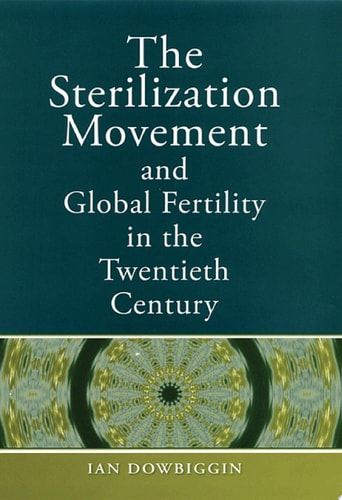
The Sterilization Movement and Global Fertility in the Twentieth Century
0
0
As an Amazon Associate and affiliate partner, Menrva Books earns from qualifying purchases. Learn more
Author Description
Many would be surprised to learn that the preferred method of birth control in the United States today is actually surgical sterilization. This book takes an historical look at the sterilization movement in post-World War II America, a revolution in modern contraceptive behavior. Focusing on leaders of the sterilization movement from the 1930's through the turn of the century, this book explores the historic linkages between environment, civil liberties, eugenics, population control, sex education, marriage counseling, and birth control movements in the 20th-century United States. Sterilization has been variously advocated as a medical procedure for defusing the "population bomb," expanding individual rights, liberating women from the fear of pregnancy, strengthening marriage, improving the quality of life of the mentally disabled, or reducing the incidence of hereditary disorders. From an historical standpoint, support for free and unfettered access to sterilization services has aroused opposition in some circles, and was considered a "liberal cause" in post-World War II America. This story demonstrates how a small group of reformers helped to alter traditional notions of gender and sexuality.
Menrva's Summary
THE THESIS
This book investigates the historical evolution of surgical sterilization as a primary method of birth control in the United States and its complex relationship with social, political, and eugenic movements throughout the twentieth century. Ian R. Dowbiggin, a historian specializing in the history of medicine and psychiatry, utilizes archival research and historical analysis to trace the influence of sterilization advocates from the 1930s to the turn of the century. He argues that the normalization of sterilization was not merely a medical advancement but a result of shifting ideologies regarding civil liberties, population control, and gender roles.
THE SCOPE MAP
What You Will Find
- Historical analysis of the sterilization movement in post-World War II America.
- Examination of the intersection between eugenics, population control, and reproductive rights.
- Documentation of the influence of reformers on modern contraceptive behavior and gender norms.
Scope Limits
- The analysis is primarily focused on the United States context rather than a comprehensive global survey.
- The text does not provide a clinical guide to medical procedures but focuses on the sociopolitical history of the practice.
THE AUTHORITY PERSPECTIVE
Experts recognize this work as a significant contribution to the history of medicine and social policy, noting its balanced approach to a controversial subject. Readers frequently highlight the academic rigor of the research and the author's ability to connect disparate social movements to the rise of modern contraceptive practices.
Page Count:
280
Publication Date:
2008-01-01
Publisher:
Oxford University Press
ISBN-10:
0190293330
ISBN-13:
9780190293338
History
Gender Studies
Allied Health
MEDICAL History
Contraception
Economics
Public Policy
Medical
Reproductive Rights
Sociology