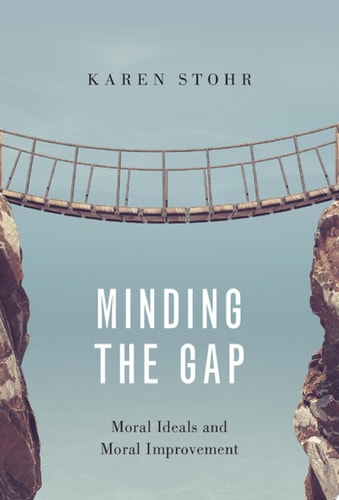
Minding the Gap: Moral Ideals and Moral Improvement
0
0
As an Amazon Associate and affiliate partner, Menrva Books earns from qualifying purchases. Learn more
Author Description
Most of us care about being a good person. Most of us also recognize that we fall far short of our morals aspirations, that there is a gap between what we are like and what we think we should be like. The aim of moral improvement is to narrow that gap. And yet as a practical undertaking, moral improvement is beset by difficulties. We are not very good judges of what we are like and we are often unclear about what it would mean to be better. This book aims to give an honest account of moral improvement that takes seriously the challenges that we encounter--the practical and philosophical--in trying to make ourselves morally better. Ethical theories routinely present us with accounts of ideal moral agents that we are supposed to emulate. These accounts, however, often lack normative authority for us and they may also fail to provide us with adequate guidance about how to live in our flawed moral reality. Stohr presents moral improvement as a project for non-ideal persons living in non-ideal circumstances. An adequate account of moral improvement must have psychologically plausible starting points and rely on ideals that are normatively authoritative and regulatively efficacious for the person trying to emulate them. Moral improvement should be understood as the project of articulating and inhabiting an aspirational moral identity. That identity is cultivated through existing practical identities and standpoints, which are fundamentally social and which generate practical conflicts about how to live. The success of moral improvement depends on it taking place within what she calls good "moral neighborhoods." Moral neighborhoods are collaborative normative spaces, constructed from networks of social practices and conventions, in which we can articulate and act as better versions of ourselves. The book concludes with a discussion of three social practices that contribute to good moral neighborhoods, and so to moral improvement.
Menrva's Summary
THE THESIS
This book investigates the practical and philosophical challenges inherent in the project of moral improvement for non-ideal agents. Karen Stohr, a professor of philosophy, draws upon ethical theory and social psychology to argue that moral growth requires moving beyond abstract ideals toward the cultivation of an aspirational moral identity. She posits that true improvement is contingent upon the existence of supportive social environments, which she terms moral neighborhoods, rather than solitary willpower alone.
THE SCOPE MAP
What You Will Find
- A framework for understanding moral identity as an extension of existing practical identities.
- An analysis of the role of social practices and conventions in shaping individual ethics.
- A discussion of three specific social practices that facilitate the creation of moral neighborhoods.
Scope Limits
- The text does not provide a prescriptive self-help manual or a step-by-step guide for personal character development.
- It does not offer a comprehensive survey of all historical ethical theories regarding moral perfection.
THE AUTHORITY PERSPECTIVE
Scholars and students of ethics frequently note the book's success in bridging the gap between abstract moral theory and the realities of human psychology. Experts highlight this as a significant contribution to contemporary virtue ethics that provides a realistic, grounded approach to moral development.
Page Count:
272
Publication Date:
2019-01-01
Publisher:
Oxford University Press
ISBN-10:
019086754X
ISBN-13:
9780190867546
Philosophy
Ethics
Social Philosophy
Social ethics
Moral Philosophy
Community Tags
Similar Books