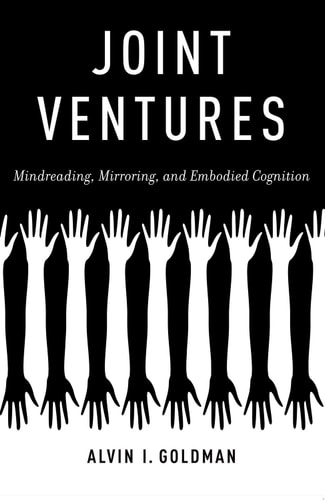
Joint Ventures: Mindreading, Mirroring, and Embodied Cognition
0
0
As an Amazon Associate and affiliate partner, Menrva Books earns from qualifying purchases. Learn more
Author Description
What distinguishes humankind from other species? A leading candidate is our facility at mutual understanding ("theory of mind"), our ability to ascribe thoughts, desires, and feelings to one another. How do we do this? Folk-wisdom says, "By empathy--we put ourselves in other people's shoes". In the last few decades this idea has moved from folk-wisdom to philosophical conjecture to serious scientific theory.This volume collects essays by Alvin Goldman, many of which have played a major role in crystallizing this "simulation," or "empathizing," account of mindreading and showing how it is confirmed by recent findings in psychology and cognitive neuroscience. Regions of your brain resonate with the brains of others when you observe them manifest their feelings in facial affect or see them about to undergo a painful stimulus or a mere touch on the arm. Essays in the volume explore an array of topics in the philosophy of cognitive science, ranging from embodied cognition to the metaphysics of actions and events. "Embodied cognition" is a catch-phrase for a family of current proposals in the philosophy of cognitive science. Some of these call for a radical re-shaping of cognitive science and others for a more measured response to repeated experimental findings that the body--or representations of the body--figure more prominently in cognition than previously recognized. Goldman dives into this terrain with a theory that brings coherence and unity to a large swath of scientific evidence. Other essays revisit his earlier work on action individuation but reconfigure it with a psychologizing twist. The final essay prepares the reader for a futuristic scenario: a book presents you with eerily accurate accounts of your past life, your present thoughts, and even your upcoming decisions. How should you respond to it?
Menrva's Summary
THE THESIS
This volume investigates the mechanisms of human mindreading and the role of embodied cognition in our ability to ascribe mental states to others. Alvin I. Goldman, a prominent philosopher of cognitive science, synthesizes decades of his research to argue for a simulation-based account of empathy. By integrating findings from psychology and neuroscience, he posits that our capacity to understand others is rooted in neural resonance and the physical representation of bodily states.
THE SCOPE MAP
What You Will Find
- Theoretical frameworks for simulation-based mindreading
- Analysis of mirror neuron systems and neural resonance
- Philosophical inquiries into the metaphysics of actions and events
- Discussions on the role of the body in cognitive processes
- Case studies and experimental evidence from cognitive neuroscience
Scope Limits
- The text does not provide a comprehensive history of all theories of mind
- It does not offer clinical applications for psychological disorders
THE AUTHORITY PERSPECTIVE
Experts recognize this collection as a significant contribution to the philosophy of mind, particularly for its bridge between conceptual analysis and empirical neuroscience. Readers frequently note the academic density of the prose, which requires a foundational understanding of cognitive science terminology to fully grasp the arguments presented.
Page Count:
360
Publication Date:
2017-11-01
Publisher:
Oxford University Press
ISBN-10:
0190869569
ISBN-13:
9780190869564
Psychology
Philosophy
Neuroscience
Embodied Cognition
Theory of Mind
Community Tags
Similar Books