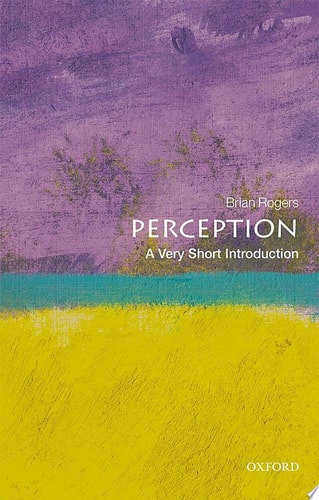
Perception: A Very Short Introduction
0
0
As an Amazon Associate and affiliate partner, Menrva Books earns from qualifying purchases. Learn more
Author Description
Perception is one of the oldest and most deeply investigated topics in the field of psychology, and it also raises some profound philosophical questions. It is concerned with how we use the information reaching our senses to guide and control our behaviour as well as to create our particular, subjective experiences of the surrounding world. In this Very Short Introduction, Brian J. Rogers discusses the philosophical question of what it means to perceive, as well as describing how we are able to perceive the particular characteristics of objects and scenes such as their lightness, colour, form, depth, and motion. What we perceive, however, does not always correspond to what exists in the world and, as Rogers shows, the study of illusions can be useful in telling us something about the nature and limitations of our perceptual processes. Rogers also explores perception from an evolutionary perspective, explaining how evolutionary pressures have shaped the perceptual systems of humans and other animals. He shows that perception is not necessarily a separate and independent process but rather part of a 'perceptual system', involving both the extraction of perceptual information and the control of action. Rogers goes on to cover the significant progress made recently in the understanding of perception through the use of precise and controlled psychophysical methods, single cell recordings, and imaging techniques. There have also been many insights from attempts to model perceptual processes in artificial systems. As Rogers shows, these attempts have revealed how difficult it is to programme machines to perform even the most simple of perceptual tasks that we take for granted. About the series: The Very Short Introductions series from Oxford University Press contains hundreds of titles in almost every subject area. These pocket-sized books are the perfect way to get ahead in a new subject quickly. Our expert authors combine facts, analysis, perspective, new ideas, and enthusiasm to make interesting and challenging topics highly readable.
Menrva's Summary
THE THESIS
How do humans and animals translate sensory input into subjective experiences and guide behavior through the complex mechanisms of perception? Brian J. Rogers, an expert in the field, examines the intersection of psychology and philosophy to explain how sensory information is processed. He utilizes historical inquiry, evolutionary theory, and modern scientific methodology to argue that perception is an integrated system rather than an isolated cognitive function.
THE SCOPE MAP
What You Will Find
- Analysis of perceptual characteristics including lightness, color, form, depth, and motion
- Examination of illusions as indicators of perceptual limitations
- Discussion of evolutionary pressures on sensory systems
- Overview of psychophysical methods, single-cell recordings, and imaging techniques
- Comparison between biological perception and artificial intelligence modeling
Scope Limits
- Does not provide an exhaustive clinical manual for sensory disorders
- Does not offer a comprehensive history of every philosophical theory of mind
THE AUTHORITY PERSPECTIVE
Experts and readers recognize this text as a concise and accessible entry point into the cognitive science of perception. The prose is noted for its ability to distill complex neuroscientific and philosophical concepts into a format suitable for students and interested laypeople.
Page Count:
144
Publication Date:
2017-01-01
Publisher:
Oxford University Press
ISBN-10:
0192508504
ISBN-13:
9780192508508
Psychology
Philosophy
Non-Fiction
Neuroscience
Community Tags
Other Editions(2)
Similar Books


Reader Comments
Share Your Thoughts
No comments yet. Be the first to share your thoughts!