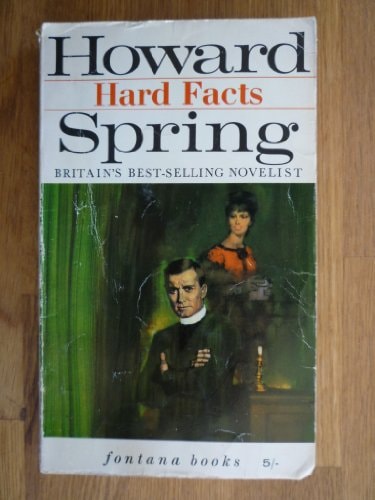
Hard Facts
0
0
As an Amazon Associate and affiliate partner, Menrva Books earns from qualifying purchases. Learn more
Author Description
HARD FACTS BY HOWARD SPRING AUTHORS FOREWORD IN a celebrated essay, Jfacaulay sums up Bacons career as a chequered spectacle of so much glory and so much shame. The words may fitly enough be applied not only to Bacons life but to most mens lives and to most large experiments of human action. In 1942 I began to write a novel whose purpose was to trace the course of one such experiment from its beginnings In the eighties of last century up to our present time. I intended to call this novel, which would, have been very long, So Much Glory: So Much Shame. It seemed to me as time went on that the war years, with the paper shortage, were not the best for the publication of so long a book as I had in mind. And, too, my writing during the war is so sporadic and occasional that progress was slow, and it might be years before the book as I con ceived it or at any rate as my conception worked out in practice was finished. Things being thus, I decided that it would be better to publish the book piecemeal. In my plan, it was divided into three parts called Hard Fads, Dunkerleys and The Banner. The first of these is the present volume, which makes, I think, a rounded and selfsufficient story. I hope that, in due course, the other volumes will do so, too and that finally it may be possible to publish the three as one book bearing the title originally chosen for it. H. S. "CHAPTER ONE AT FIVE OCLOCK on a Wednesday afternoon in March, 1885, Theodore Chrystal was walking to his lodgings in Hardiman Street, in the Levenshulme district of Manchester. He was happy enough, though no physical reason for happiness was apparent. It was a vile day the darkness had come down on the breath of a thin fog, and the street lamps had not yet been lit. Even had the full light of a summers day fallen upon the scene, it would have been hideous. Theo knew this, although Manchester was a strange town to him, for there had been light enough when he set out to take tea with Mr. Burnside, the Vicar of St.
Menrva's Summary
THE PULSE
Theodore Chrystal, a young man navigating the industrial landscape of 1880s Manchester, finds his life irrevocably altered by the rigid social structures and moral dilemmas of his era. As he attempts to establish his footing in a city defined by its grim atmosphere and economic disparity, he encounters forces that challenge his personal integrity and ambition. The narrative, presented with a focus on character development and environmental detail, follows his progression through a series of events that test his resolve. The story functions as the initial installment of a larger, multi-part exploration of human ambition and societal change.
INSIDE THE PAGES
- Detailed depiction of late 19th-century Manchester industrial life
- Exploration of the tension between individual morality and social advancement
- Focus on the ecclesiastical and working-class dynamics of the period
- Character-driven narrative structure emphasizing personal growth
- Atmospheric prose capturing the physical environment of the Victorian era
- Examination of the consequences of human ambition and experimentation
- Episodic narrative design intended to function as a self-sufficient volume
- Themes of social mobility and the struggle for identity in a changing world
THE COLLECTIVE ECHO
This work is often analyzed as a quintessential example of mid-20th-century British social realism that looks back at the Victorian era. The narrative style is noted for its steady pacing and its commitment to grounding character arcs within the specific economic and social pressures of the time. Readers and critics frequently highlight the author's ability to render the grit of Manchester with a sense of historical authenticity. The book serves as a foundational piece for the broader trilogy, establishing the thematic groundwork for the subsequent volumes. Its reception is characterized by an appreciation for the author's traditional storytelling craft and his focus on the intersection of personal life and historical change.
Page Count:
256
Publication Date:
1969-01-01
Publisher:
Fontana
ISBN-10:
0006119859
ISBN-13:
9780006119852
Historical Fiction
Romance
Fiction
History
Contemporary
Genre Fiction
British literature
Family Saga
Social Realism
Classic Literature
Literary
Literature & Fiction
Community Tags
Other Editions(2)

Similar Books

Reader Comments
Share Your Thoughts
No comments yet. Be the first to share your thoughts!