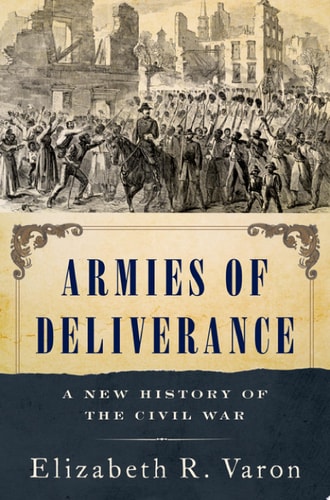
Armies of Deliverance: A New History of the Civil War
0
0
As an Amazon Associate and affiliate partner, Menrva Books earns from qualifying purchases. Learn more
Author Description
Loyal Americans marched off to war in 1861 not to conquer the South but to liberate it. So argues Elizabeth R. Varon in Armies of Deliverance, a sweeping narrative of the Civil War and a bold new interpretation of Union and Confederate war aims. Northerners imagined the war as a crusade to deliver the Southern masses from slaveholder domination and to bring democracy, prosperity, and education to the region. As the war escalated, Lincoln and his allies built the case that emancipation would secure military victory and benefit the North and South alike. The theme of deliverance was essential in mobilizing a Unionist coalition of Northerners and anti-Confederate Southerners. Confederates, fighting to establish an independent slaveholding republic, were determined to preempt, discredit, and silence Yankee appeals to the Southern masses. In their quest for political unity Confederates relentlessly played up two themes: Northern barbarity and Southern victimization. Casting the Union army as ruthless conquerors, Confederates argued that the emancipation of blacks was synonymous with the subjugation of the white South. Interweaving military and social history, Varon shows that everyday acts on the ground--from the flight of slaves, to protests against the draft, the plundering of civilian homes, and civilian defiance of military occupation--reverberated at the highest levels of government. Varon also offers new perspectives on major battles, illuminating how soldiers and civilians alike coped with the physical and emotional toll of the war as it grew into a massive humanitarian crisis. The Union's politics of deliverance helped it to win the war. But such appeals failed to convince Confederates to accept peace on the victor's terms, ultimately sowing the seeds of postwar discord. Armies of Deliverance offers innovative insights on the conflict for those steeped in Civil War history and novices alike.
Menrva's Summary
THE THESIS
How did the concept of 'deliverance' shape the strategic objectives and political rhetoric of both the Union and the Confederacy during the American Civil War? Elizabeth R. Varon, a professor of history, utilizes a synthesis of military and social records to argue that the Union framed the conflict as a mission to liberate Southern non-slaveholders from the influence of the planter class. This framework of deliverance served as a primary tool for mobilizing Northern support and undermining Confederate internal cohesion, while the Confederacy countered by framing the Union as a barbaric force of subjugation.
THE SCOPE MAP
What You Will Find
- Analysis of Union war aims regarding emancipation and democracy
- Examination of Confederate propaganda strategies concerning Northern 'barbarity'
- Integration of social history, including slave flight and civilian resistance
- Re-evaluation of major military engagements through the lens of political objectives
Scope Limits
- Does not provide a comprehensive tactical breakdown of every major battle
- Focuses primarily on the ideological and political dimensions of the conflict rather than purely logistical or economic history
THE AUTHORITY PERSPECTIVE
Historians and scholars frequently cite this work for its nuanced re-examination of Union war aims and its focus on the ideological battle for the Southern populace. Readers often note that the prose is accessible to both academic audiences and those interested in a fresh interpretation of well-trodden historical ground.
Page Count:
527
Publication Date:
2019-01-01
Publisher:
Oxford University Press
ISBN-10:
0190860626
ISBN-13:
9780190860622
History
Military History
United States
American History
Political History
Social History
Civil War
Americas
Secession
Community Tags
Similar Books