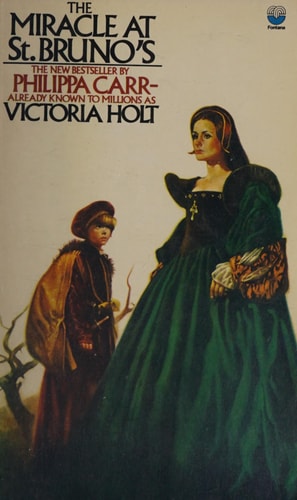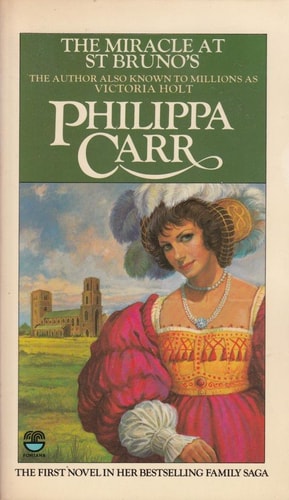
The Miracle at St. Bruno's
0
0
As an Amazon Associate and affiliate partner, Menrva Books earns from qualifying purchases. Learn more
Author Description
I was born in the September of 1523, nine months after the monks had discovered the child in the crib on that Christmas morning. My birth was, my father used to say, another miracle: He was not young at the time being forty years of age... My mother, whose great pleasure was tending her gardens, called me Damask, after the rose which Dr. Linacre, the King's physician, had brought into England that year."Thus begins the story narrated by Damask Farland, daughter of a well-to-do lawyer whose considerable lands adjoin those of St. Bruno's Abbey. It is a story of a life inextricably enmashed with that of Bruno, the mysterious child found on the abbey altar that Christmas morning and raised by the monks to become a man at once handsome and saintly, but also brooding and ominous, tortured by the secret of his origin which looms ever more menacingly over the huge abbey he comes to dominate.This is also the story of an engaging family, the Farlands. Of a fathr wise enough to understand "the happier our King is, the happier I as a true subject must be," a wife twenty years his junior, and a daughter whose intelligence is constantly to war with the strange hold Bruno has upon her destiny. What happens to the Farlands against the background of what is happening to King Henry and his court during this robust period provides a novel in which suspense and the highlights of history are wonderfully balanced.
Menrva's Summary
THE PULSE
The discovery of a mysterious foundling at St. Bruno's Abbey sets in motion a lifelong entanglement between the abbey's ward and the daughter of a neighboring lawyer. Damask Farland narrates her own life story, which becomes inextricably linked to Bruno, the enigmatic boy raised by monks who grows into a man of both saintly reputation and dark, brooding intensity. As Damask matures, she must navigate her own desires and the shifting political landscape of King Henry VIII's England, all while struggling against the inexplicable influence Bruno exerts over her future. The narrative framework utilizes a first-person perspective to explore the tension between personal autonomy and the weight of historical and domestic expectations.
INSIDE THE PAGES
- First-person retrospective narration by Damask Farland
- Setting centered on the transition of power during the reign of Henry VIII
- Exploration of the dissolution of the monasteries as a backdrop for personal conflict
- Focus on the psychological tension between the protagonist and the mysterious Bruno
- Integration of domestic family life with high-stakes political history
- Themes of destiny, secrets, and the influence of religious institutions
- Detailed period atmosphere reflecting 16th-century English social structures
- Pacing that balances character development with historical suspense
THE COLLECTIVE ECHO
This novel presents a classic example of historical romantic suspense, characterized by the author's signature focus on strong female protagonists navigating turbulent eras. The narrative relies on the interplay between the intimate domestic sphere of the Farland family and the broader, often dangerous, political machinations of the Tudor court. Readers likely find the atmospheric depiction of St. Bruno's Abbey and the central mystery surrounding Bruno's origins to be the primary drivers of the story's momentum. The work functions as a character-driven study of how individual lives are shaped by the monumental shifts in national and religious identity during the sixteenth century.
Page Count:
352
Publication Date:
1977-01-01
Publisher:
Fontana
ISBN-10:
0006143350
ISBN-13:
9780006143352
Historical Fiction
Mystery
Romance
Coming of Age
Literature & Fiction
Historical
Genre Fiction
Tudor England