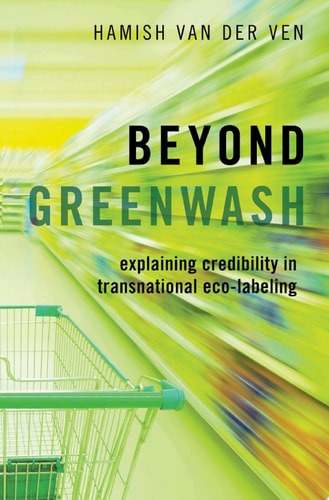
Beyond Greenwash: Explaining Credibility in Transnational Eco-Labeling
0
0
As an Amazon Associate and affiliate partner, Menrva Books earns from qualifying purchases. Learn more
Author Description
From green frogs and blue angels to white bunnies, modern consumers are confronted by a growing array of colorful eco-labels on everything from coffee to computers. When eco-labels are credible, they can lead to dramatic change in environmental practices broadly and quickly by leveraging the purchasing power of corporate clients (e.g., Walmart and McDonalds) to influence global supply chains. But the credibility of such labels is highly variable; and despite the existence of established practices for eco-labeling, many labels remain little more than superficial exercises in "greenwash." How can consumers separate greenwash from genuine attempts to address environmental challenges? Beyond Greenwash addresses this question by systematically investigating the credibility of transnational eco-labeling organizations across countries and commercial sectors. Using an innovative proxy measure for credibility that examines adherence to established best practices, Hamish van der Ven proposes a novel theory of rigor and credibility in transnational eco-labeling that upends conventional wisdom. He argues that the credibility of an eco-label does not depend on who creates or manages it-whether a government, industry association, professional standard setter, or environmental NGO. Rather, it depends on which types of businesses use the label. More specifically, eco-labeling organizations that target bigger, consumer-facing retailers tend to create credible eco-labels out of a desire to insulate their clients from critical scrutiny and gain acceptance in new markets. This theory challenges the conventional wisdom that only governments or environmental NGOs can create meaningful environmental governance and suggests that who is being governed matters as much, if not more, than who is doing the governing.
Menrva's Summary
THE THESIS
This book investigates the factors that determine the credibility of transnational eco-labeling organizations and how consumers can distinguish genuine environmental standards from superficial greenwashing. Hamish van der Ven, an expert in environmental governance, utilizes a systematic analysis of labeling organizations across various sectors and countries. He proposes a theory of rigor that shifts the focus from the identity of the label creator to the characteristics of the businesses being governed. The central argument posits that labels targeting large, consumer-facing retailers are more likely to adopt credible standards to protect their clients from public scrutiny and facilitate market entry.
THE SCOPE MAP
What You Will Find
- A comparative analysis of transnational eco-labeling organizations across diverse commercial sectors.
- An innovative proxy measure for evaluating the credibility of environmental standards.
- A theoretical framework linking corporate client profiles to the rigor of environmental governance.
Scope Limits
- The study does not provide a comprehensive directory or rating of every existing consumer eco-label.
- The analysis focuses primarily on transnational organizations rather than localized or national-only regulatory bodies.
THE AUTHORITY PERSPECTIVE
Experts in environmental policy and international relations recognize this work as a significant contribution to the study of private governance and supply chain sustainability. Readers frequently note that the text provides a rigorous, data-driven approach to understanding the mechanics of corporate environmental accountability.
Page Count:
246
Publication Date:
2019-01-01
Publisher:
Oxford University Press
ISBN-10:
0190866020
ISBN-13:
9780190866020
Economics
Corporate Responsibility
Sustainability
Business Ethics
Public Policy
Community Tags
Similar Books