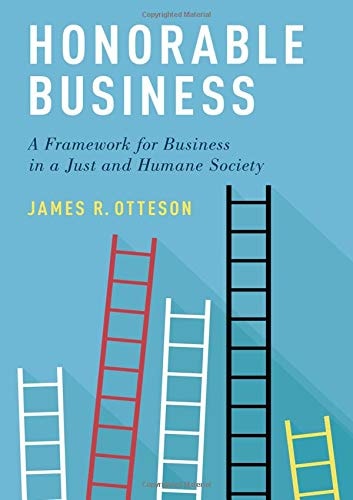
Honorable Business: A Framework for Business in a Just and Humane Society
0
0
As an Amazon Associate and affiliate partner, Menrva Books earns from qualifying purchases. Learn more
Author Description
Business has a bad name for many people. It is easy to point to unethical and damaging behavior by companies. And it may seem straightforward to blame either indivuduals or, more generally, ruthless markets and amoral commercial society.In Honorable Business, James R. Otteson argues that business activity can be valuable in itself. The primary purpose of honorable businesses is to create value-for all parties. They look for mutually voluntary and mutually beneficial transactions, so that all sides of any exchange benefit, leading to increasing prosperity not just for one person or for one group at the expense of others but simultaneously for everyone involved. Done correctly, honorable business is a positive-sum activity that can enable flourishing for individuals and prosperity for society.Otteson connects honorable business with the political, economic, and cultural institutions that contribute to a just and humane society. He builds on Aristotle's conception of human beings as purposive creatures who are capable of constructing a plan for their lives that gives them a chance of achieving the highest good for humanity, focusing on autonomy and accountability, as well as good moral judgment. This good judgment can enable us to answer the why of what we do, not just the how. He also draws on Adam Smith's moral philosophy and political economy, and argues that Smithian institutions have played a significant role in the remarkable increase in worldwide prosperity we have seen over the last two hundred years. Otteson offers a pragmatic Code of Business Ethics, linked to a specific conception of professionalism, and defends this Code on the basis of a moral mandate to use one's limited resources of time, talent, and treasure to provide value for oneself only by simultaneously providing value to others. The result is well-articulated parameters within which business can be an acceptable-perhaps even praiseworthy-activity.
Menrva's Summary
THE THESIS
This book investigates the core question of whether business activity can be inherently moral and how it contributes to a just and humane society. James R. Otteson, a professor of business ethics and philosophy, utilizes a framework grounded in Aristotelian virtue ethics and Adam Smith’s political economy to argue that honorable business is a positive-sum activity. He posits that by focusing on mutually beneficial transactions, businesses can foster individual flourishing and societal prosperity while adhering to a clear moral mandate.
THE SCOPE MAP
What You Will Find
- A philosophical framework connecting business practices to human flourishing.
- An analysis of Adam Smith’s moral philosophy and its application to modern economics.
- A pragmatic Code of Business Ethics centered on autonomy and accountability.
- Arguments regarding the role of institutional structures in enabling ethical commerce.
Scope Limits
- The text does not provide a comprehensive history of global corporate law.
- It does not offer specific technical accounting or management strategies for day-to-day operations.
THE AUTHORITY PERSPECTIVE
Scholars and business professionals frequently note the book's success in bridging the gap between abstract moral philosophy and practical business conduct. Experts highlight this as a useful resource for those seeking to reconcile commercial ambition with ethical responsibility in a modern market economy.
Page Count:
250
Publication Date:
2019-02-27
Publisher:
Oxford University Press
ISBN-10:
0190914203
ISBN-13:
9780190914202
Philosophy
Economics
Business Ethics
Professionalism
Corporate Responsibility
Community Tags
Other Editions(2)
Similar Books


Reader Comments
Share Your Thoughts
No comments yet. Be the first to share your thoughts!