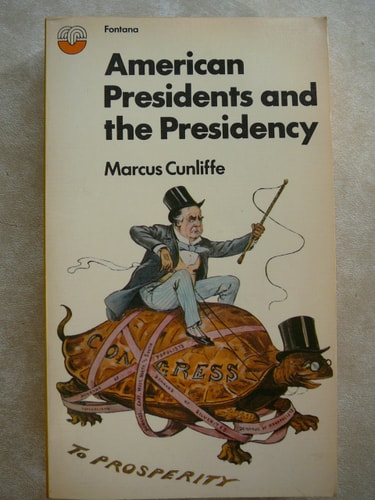
American Presidents and the Presidency
0
0
As an Amazon Associate and affiliate partner, Menrva Books earns from qualifying purchases. Learn more
Author Description
Traces the debates over the Federalist and Republican approaches of the Founding Fathers; the fissures in the Federalist period; the intrusion of populism in the campaign of Andrew Jackson; the significance of popular versus electoral college votes; Woodrow Wilson's divisive relationship with Congress; F.D.R.'s expansion of presidential power; and McCarthyism and the crosscurrent of the postwar era. Examines Richard Nixon and the Watergate debacle.
Menrva's Summary
THE THESIS
This work investigates the evolution of the American executive office by analyzing the inherent tensions between constitutional design and the shifting realities of political power. Marcus Cunliffe, a distinguished historian of American culture, synthesizes constitutional theory with the practical application of presidential authority across two centuries. He argues that the presidency is a dynamic institution, shaped as much by the personalities of its occupants as by the structural constraints of the American political system.
THE SCOPE MAP
What You Will Find
- Analysis of the ideological divide between Federalist and Republican approaches during the Founding era.
- Examination of the rise of populism through the lens of the Andrew Jackson administration.
- Evaluation of the expansion of executive power during the Franklin D. Roosevelt era.
- Discussion of the institutional conflicts between the presidency and Congress, specifically regarding Woodrow Wilson and the Watergate crisis.
THE AUTHORITY PERSPECTIVE
This text provides a scholarly, historical overview of the presidency that emphasizes the structural and cultural forces that have defined the office. The analysis remains grounded in the historical context of the mid-twentieth century, offering a balanced perspective on the development of executive power.
Page Count:
384
Publication Date:
1972-04-01
Publisher:
Fontana
ISBN-10:
0006329071
ISBN-13:
9780006329077
Biography
History
Politics
Government
American History
Community Tags
Similar Books














