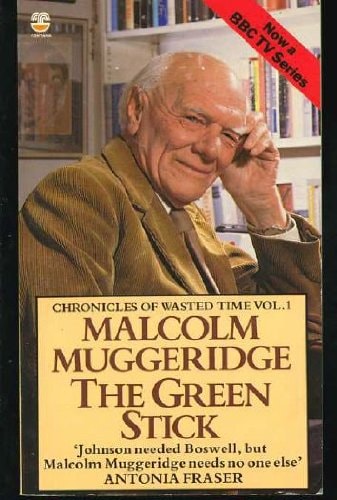
Chronicles of Wasted Time: The Green Stick
0
0
As an Amazon Associate and affiliate partner, Menrva Books earns from qualifying purchases. Learn more
Author Description
It was a fancy of Tolstoy's that somewhere, buried underground, if you could but find it, was a Green Stick with the secret of everlasting happiness carved upon it.Malcolm Muggeridge's quest for the Green Stick began under the aegis of his father, an ardent pioneer Socialist, and ended abruptly in Russia in 1933 under that of Stalin. In between he had spent four unprofitable years at Cambridge and another four initiating Indian and Egyptian students into the mysteries of English Literature.Marriage to the niece of Beatrice and Sidney Webb introduced him to the top social elite of the Left, and a corresponding elevation was attained when he found himself in the sacred corridors of the Manchester Guardian dispensing the pure world of Liberalism at the behest of its great editor, C.P. Scott.Yet this did not quite satisfy. So off he went with his wife Kitty to the U.S.S.R., where Aunt Beatrice and Uncle Sidney were icons, and the New Civilization they had proclaimed was taking shape - only to retreat, after a season, in through disillusionment.Mr. Muggeridge's account of this unfulfilled quest brilliantly recalls and illuminate the post-World War I years. It is superbly funny, impeccably well observed and precise, with portraits of his friends and contemporaries shining like beams along the way. And beneath the wit and the epigrams runs a fierce love of humanity - disenchanted often, angry sometimes, despairing never."I have always loved words," Mr. Muggeridge observes early in his book, "and still love them, for their own sake. For the power and beauty of them; for the wonderful things that can be done with them." Reading his words, the reader becomes similarly beguiled - and hopes for other Chronicles to follow.
Menrva's Summary
THE THESIS
Malcolm Muggeridge investigates the disillusionment of the post-World War I intellectual class through the lens of his own search for meaning and truth. The author, a prominent British journalist and social critic, draws upon his personal history—from his upbringing in a socialist household to his disillusioning experiences in the Soviet Union—to critique the political and social ideologies of his time. By examining his interactions with the elite of the British Left and his eventual rejection of their utopian visions, he constructs a narrative that questions the efficacy of political dogma in achieving human happiness.
THE SCOPE MAP
What You Will Find
- A detailed account of the political climate in Britain and the Soviet Union during the interwar period.
- Observations on the intellectual culture of Cambridge and the editorial practices of the Manchester Guardian.
- Personal reflections on the influence of figures such as Beatrice and Sidney Webb.
- A critical analysis of the socialist movement and the reality of life under Stalinist rule.
THE AUTHORITY PERSPECTIVE
This work is regarded as a significant piece of 20th-century autobiographical writing, noted for its sharp wit and cynical, yet deeply humanistic, perspective. The text provides a dense, reflective look at the ideological shifts of the era, making it a valuable resource for readers interested in the intersection of personal biography and political history.
Page Count:
316
Publication Date:
1972-01-01
Publisher:
FONTANA
ISBN-10:
0006361919
ISBN-13:
9780006361916
Memoir
History
Autobiography
Leaders & Notable People
Religious
Journalists
British literature
Community Tags
Similar Books