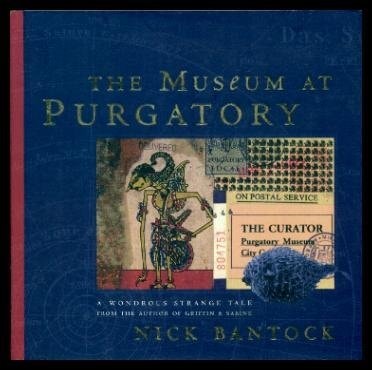
The Museum at Purgatory: A Wondrous Strange Tale from the Author of Griffin and Sabine
0
0
As an Amazon Associate and affiliate partner, Menrva Books earns from qualifying purchases. Learn more
Author Description
Nick Bantock first burst onto the literary scene in 1991 with his remarkable illustrated novel Griffin & Sabine--which was as much art as it was artifice. While chronicling the correspondence between two mysterious lovers, Bantock peppered his book with visual delights--macabre post cards, intricately designed stamps, exquisite envelopes that open to disclose hand-written letters. Sabine's Notebook and The Golden Mean soon followed to complete the trilogy. In many respects, The Museum at Purgatory resembles its predecessors, mixing metaphysics and art in a way meant to both puzzle and delight its readers. The narrator offers the basic premise early "My name is Non, and as Curator of the Museum here at Purgatory I am required by statute to facilitate, without judgment, the progress of all collectors assigned to these halls. It is my responsibility to act as their souls' guardian, as well as preserver of their accumulated treasures." Non then goes on to give a brief overview of the layout of Purgatory, a city that "takes a meditative, non-partisan view of reality" and where visitors are "faced with fundamental questions of self-worth" that must be resolved before they can move on. In other words, this stopping place between heaven and hell is one big analyst's couch. Non's introduction to Purgatory scans like the overly formal, academic language one finds on informational panels in natural history museums--no doubt Bantock's intention. Unfortunately, this can become wearing after a while, and it isn't until the second half of the book when Non tells his own story (as opposed to the histories of the various "collections" under his care) that the prose loosens up somewhat.But it's the illustrations that make Bantock's books special; it's unfortunate that several of them look as if they've escaped from a Dorling Kindersley guidebook--photographs of objects on stark backgrounds with a caption explaining their significance or use. Yet this museum contains some lovely examp
Menrva's Summary
THE PULSE
Non, the curator of a museum located in the purgatorial afterlife, must guide souls through their final existential resolutions while managing the artifacts they have accumulated throughout their lives. As the narrator, Non operates within a rigid, bureaucratic framework, tasked with facilitating the progress of collectors who are trapped between existence and transcendence. The narrative unfolds through a blend of formal, museum-style exposition and personal reflection, forcing the protagonist to confront his own history as he observes the psychological burdens of those under his care. The world is presented as a meditative, non-partisan space where the physical environment mirrors the internal state of the visitors, creating a surreal landscape of self-worth and memory.
INSIDE THE PAGES
- Epistolary-adjacent narrative structure utilizing museum-style informational panels.
- Heavy integration of visual art and collage-style illustrations.
- Metaphysical exploration of the afterlife as a psychological transition space.
- First-person perspective from an immortal, bureaucratic narrator.
- Focus on the symbolic significance of material objects and collections.
- Stylistic shift from formal, academic prose to intimate, personal confession.
- Surrealist world-building that treats purgatory as a physical, navigable city.
- Thematic examination of the relationship between memory, identity, and ownership.
THE COLLECTIVE ECHO
This work is characterized by its distinct fusion of visual art and metaphysical inquiry, which mirrors the stylistic hallmarks of the author's previous successes. The narrative structure relies heavily on the tension between the clinical, detached voice of the curator and the deeply personal histories of the souls he oversees. Readers often note the deliberate artifice of the presentation, which functions as both a storytelling device and a thematic commentary on the nature of collecting. The pacing is intentionally meditative, prioritizing atmosphere and visual detail over traditional plot progression, which suggests a reading experience that favors contemplation over rapid narrative momentum.
Page Count:
113
Publication Date:
2000-01-01
Publisher:
HarperCollins Canada, Limited
ISBN-10:
0006485162
ISBN-13:
9780006485162
Fantasy
Fiction
Experimental
Museums
Purgatory
Future life
Surrealism
Metaphysical
Artistic Fiction