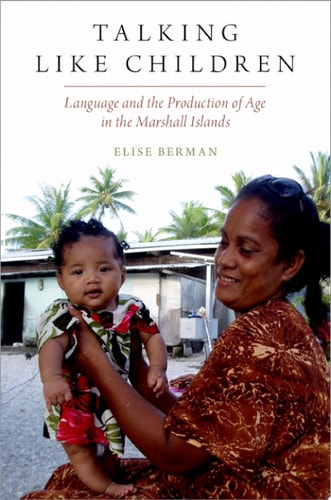
Talking Like Children: Language and the Production of Age in the Marshall Islands
0
0
As an Amazon Associate and affiliate partner, Menrva Books earns from qualifying purchases. Learn more
Author Description
Children in the Marshall Islands do many things that adults do not. They walk around half naked. They carry and eat food in public without offering it to others. They talk about things they see rather than hiding uncomfortable truths. They explicitly refuse to give. Why do they do these things?Many think these behaviors are a natural result of children's innate immaturity. But Elise Berman argues that children are actually taught to do things that adults avoid: to be rude, inappropriate, and immature. Before children learn to be adults, they learn to be different from them. Berman's main theoretical claim therefore is also a novel one: age emerges through interaction and is a social production. In Talking Like Children, Berman analyzes a variety of interactions in the Marshall Islands, all broadly based around exchange: adoption negotiations, efforts to ask for or avoid giving away food, contentious debates about supposed child abuse. In these dramas both large and small, age differences emerge through the decisions people make, the emotions they feel, and the power they gain. Berman's research includes a range of methods -- participant observation, video and audio recordings, interviews, children's drawings -- that yield a significant corpus of data including over 80 hours of recorded naturalistic social interaction. Presented as a series of captivating stories, Talking Like Children is an intimate analysis of speech and interaction that shows what age means. Like gender and race, age differences are both culturally produced and socially important. The differences between Marshallese children and adults give both groups the ability to manipulate social life in distinct but often complementary ways. These differences produce culture itself. Talking Like Children establishes age as a foundational social variable and a central concern of anthropological and linguistic research.
Menrva's Summary
THE THESIS
How is age socially constructed and maintained through linguistic interaction and cultural practice in the Marshall Islands? Elise Berman, an anthropologist specializing in the study of language and childhood, posits that age is not a biological inevitability but a social production. By examining how Marshallese children are actively taught to exhibit behaviors that adults avoid, she argues that age differences serve as a foundational variable for navigating social power and cultural exchange.
THE SCOPE MAP
What You Will Find
- Analysis of social interactions including adoption negotiations and food exchange debates.
- A methodology combining participant observation with over 80 hours of audio and video recordings.
- Theoretical framework positioning age alongside gender and race as a socially produced category.
Scope Limits
- The study is geographically confined to the Marshall Islands and does not provide a cross-cultural comparison of childhood development.
- The research focuses primarily on linguistic and social interaction rather than biological or psychological developmental milestones.
THE AUTHORITY PERSPECTIVE
Scholars in linguistic anthropology recognize this work as a significant contribution to the study of age as a social construct. Readers frequently note the academic density of the prose, which effectively bridges ethnographic storytelling with rigorous theoretical analysis.
Page Count:
223
Publication Date:
2019-01-01
Publisher:
Oxford University Press
ISBN-10:
0190877006
ISBN-13:
9780190877002
Age Groups
Sociology
Anthropology
Cultural Anthropology
English
English & College Success
Exchange
Marshall Islands
Linguistics
Community Tags
Similar Books