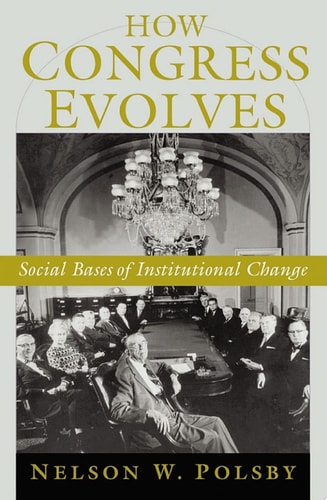
How Congress Evolves: Social Bases of Institutional Change
0
0
As an Amazon Associate and affiliate partner, Menrva Books earns from qualifying purchases. Learn more
Author Description
From the end of the New Deal until quite recently, the U.S. House of Representatives was dominated by a conservative coalition that thwarted the Democratic majority and prevented the enactment of measures proposed by a succession of liberal Presidents. Today Presidents aren't necessarily liberal and the House of Representatives is not necessarily the graveyard of presidential proposals. What happened? Congress evolved. It all began with airconditioning. In this entertaining tale of one of our most august institutions, Nelson Polsby describes how the Democratic majority finally succeeded in overcoming the conservative coalition, changing the House. The evolution required among other things, the disappearance of Dixiecrats from the House Democratic caucus. Dixiecrats were replaced by the rise of the Republican party in the south. The Republican party in southern states was strengthened by an influx of migrants from the north, who came south to settle after the introduction of residential air conditioning, which made the climate more tolerable to Northerners. This evolutionary process led to the House's liberalization and concluded with the House's later transformation into an arena of sharp partisanship, visible among both Democrats and Republicans. A fascinating read by one of our most influential political scientists, How Congress Evolves breathes new life into the dusty corners of institutional history, and offers a unique explanation for important transformations in the congressional environment.
Menrva's Summary
THE THESIS
This work investigates the mechanisms of institutional change within the U.S. House of Representatives, specifically questioning how the body transitioned from a conservative-dominated coalition to a highly partisan arena. Nelson W. Polsby, a prominent political scientist, utilizes historical analysis and institutional theory to argue that environmental and demographic shifts—rather than purely ideological shifts—drove this evolution. He posits that technological advancements, such as residential air conditioning, facilitated migration patterns that fundamentally altered the political composition of the South and, consequently, the legislative behavior of Congress.
THE SCOPE MAP
What You Will Find
- Analysis of the decline of the conservative coalition in the mid-20th century.
- Examination of the impact of demographic shifts on Southern political representation.
- Discussion of the role of technological innovation in shaping regional political climates.
- Overview of the transition toward modern, high-stakes partisanship in the House.
Scope Limits
- The text does not provide a comprehensive history of all congressional committees or procedural rules.
- It focuses primarily on the House of Representatives rather than the Senate or the executive branch's internal operations.
THE AUTHORITY PERSPECTIVE
Political scientists frequently cite this work as a significant contribution to understanding the intersection of technology, geography, and legislative behavior. Readers often note that the prose is accessible while maintaining the analytical rigor expected of institutional history.
Page Count:
267
Publication Date:
2003-01-01
Publisher:
Oxford University Press
ISBN-10:
0190289899
ISBN-13:
9780190289898
United States
American Government
Legislative Studies
Government
American History
Institutional Change
Community Tags
Similar Books