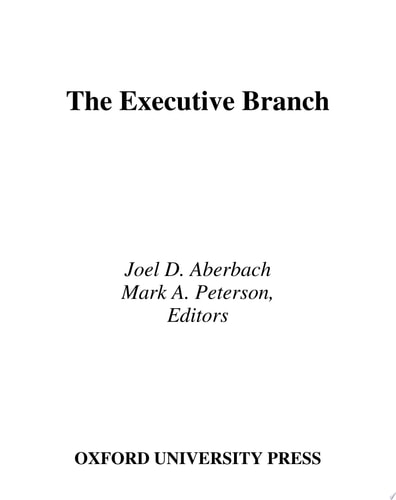
The Executive Branch: The Executive Branch The Executive Branch (Institutions of American Democracy)
0
0
As an Amazon Associate and affiliate partner, Menrva Books earns from qualifying purchases. Learn more
Author Description
The presidency and the agencies of the executive branch are deeply interwoven with other core institutions of American government and politics. While the framers of the Constitution granted power to the president, they likewise imbued the legislative and judicial branches of government with the powers necessary to hold the executive in check. The Executive Branch, edited by Joel D. Aberbach and Mark A. Peterson, examines the delicate and shifting balance among the three branches of government, which is constantly renegotiated as political leaders contend with the public's paradoxical sentiments-yearning for strong executive leadership yet fearing too much executive power, and welcoming the benefits of public programs yet uneasy about, and indeed often distrusting, big government. The Executive Branch, a collection of essays by some of the nation's leading political scientists and public policy scholars, examines the historical emergence and contemporary performance of the presidency and bureaucracy, as well as their respective relationships with the Congress, the courts, political parties, and American federalism. Presidential elections are defining moments for the nation's democracy-by linking citizens directly to their government, elections serve as a mechanism for exercising collective public choice. After the election, however, the work of government begins and involves elected and appointed political leaders at all levels of government, career civil servants, government contractors, interest organizations, the media, and engaged citizens. The essays in this volume examine the organizations and politics that make the executive branch such a complex and fascinating part of American government. The volume provides an assessment from the past to the present of the role and development of the presidency and executive branch agencies, including analysis of the favorable and problematic strategies, and personal attributes, that presidents have brought to the office.
Menrva's Summary
THE THESIS
How does the executive branch maintain its functional balance within the complex, tripartite structure of American democracy? Editors Joel D. Aberbach and Mark A. Peterson curate a collection of essays from prominent political scientists and policy scholars to analyze the evolution of the presidency and federal bureaucracy. The text utilizes historical analysis and contemporary political theory to examine the tension between the public's desire for strong executive leadership and their inherent distrust of centralized government power. By mapping the interactions between the executive, legislative, and judicial branches, the authors provide a framework for understanding how political power is negotiated and constrained in the United States.
THE SCOPE MAP
What You Will Find
- Historical development of the presidency and federal agencies from the Constitutional era to the present.
- Analysis of the interdependencies between the executive branch, Congress, the judiciary, and political parties.
- Examination of the role of career civil servants, government contractors, and interest groups in policy implementation.
- Assessment of the impact of presidential elections on public choice and the subsequent mechanics of governance.
THE AUTHORITY PERSPECTIVE
Experts recognize this volume as a comprehensive academic resource for understanding the structural complexities of the American executive branch. Readers frequently note the scholarly density of the prose, making it a standard reference for students and researchers of American political institutions.
Page Count:
632
Publication Date:
2005-10-27
Publisher:
Oxford University Press
ISBN-10:
0199883955
ISBN-13:
9780199883950
Non-Fiction
American Government
American History
Public Policy
Government
Community Tags
Similar Books
Reader Comments
Share Your Thoughts
No comments yet. Be the first to share your thoughts!