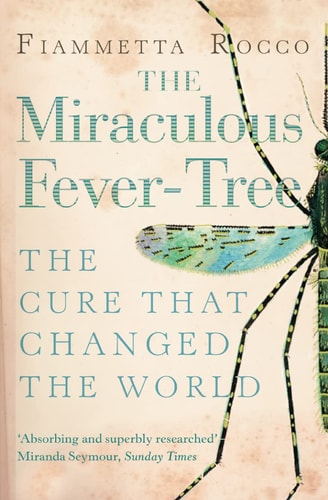
The Miraculous Fever-Tree: The Cure That Changed the World
0
0
As an Amazon Associate and affiliate partner, Menrva Books earns from qualifying purchases. Learn more
Author Description
A rich and wonderful history of quinine - the cure for malaria. In the summer of 1623, ten cardinals and hundreds of their attendants, engaged in electing a new Pope, died from the 'mal'aria' or 'bad air' of the Roman marshes. Their choice, Pope Urban VIII, determined that a cure should be found for the fever that was the scourge of the Mediterranean, northern Europe and America, and in 1631 a young Jesuit apothecarist in Peru sent to the Old World a cure that had been found in the New - where the disease was unknown.The cure was quinine, an alkaloid made of the bitter red bark of the cinchona tree, which grows in the Andes. Both disease and cure have an extraordinary history. Malaria badly weakened the Roman Empire. It killed thousands of British troops fighting Napoleon during the Walcheren raid on Holland in 1809 and many soldiers on both sides of the American Civil War. It turned back many of the travellers who explored west Africa and brought the building of the Panama Canal to a standstill. When, after a thousand years, a cure was finally found, Europe's Protestants, among them Oliver Cromwell, who suffered badly from malaria, feared it was nothing more than a Popish poison. More than any previous medicine, though, quinine forced physicians to change their ideas about treating illness. Before long, it would change the face of Western medicine.Using fresh research from the Vatican and the Indian Archives in Seville, as well as hitherto undiscovered documents in Peru, Fiammetta Rocco describes the ravages of the disease, the quest of the three Englishmen who smuggled cinchona seeds out of South America, the way quinine opened the door to Western imperial adventure in Asia, Africa and beyond, and why, even today, quinine grown in the eastern Congo still saves so many people suffering from malaria.
Menrva's Summary
THE THESIS
This work investigates the historical impact of quinine, the first effective treatment for malaria, and how its discovery fundamentally altered the trajectory of Western medicine and global exploration. Fiammetta Rocco, an experienced journalist and author, synthesizes archival research from the Vatican, the Indian Archives in Seville, and newly discovered documents from Peru to construct a comprehensive narrative. The book argues that the cinchona tree's bark did more than cure a fever; it enabled imperial expansion and forced a paradigm shift in how physicians approached the treatment of illness.
THE SCOPE MAP
What You Will Find
- The historical progression of malaria from the Roman Empire through the American Civil War and the construction of the Panama Canal.
- The geopolitical consequences of quinine, including its role in facilitating European colonial expansion into Africa and Asia.
- Primary source evidence derived from Vatican records, Spanish colonial archives, and Peruvian historical documents.
- A detailed account of the clandestine smuggling of cinchona seeds out of South America by British agents.
THE AUTHORITY PERSPECTIVE
The text provides a dense, well-documented examination of medical history that bridges the gap between botanical discovery and global political power. Its reliance on primary archival research makes it a significant resource for readers interested in the intersection of science and imperial history.
Page Count:
348
Publication Date:
2004-01-01
Publisher:
HarperCollins
ISBN-10:
0006532357
ISBN-13:
9780006532354
Science
History
Biography
Non-Fiction
Disease & Health Issues
MEDICAL History
Social Science
Medical
Europe
Science
Medicine
Infectious Diseases
Italy
Physics
Community Tags
Similar Books