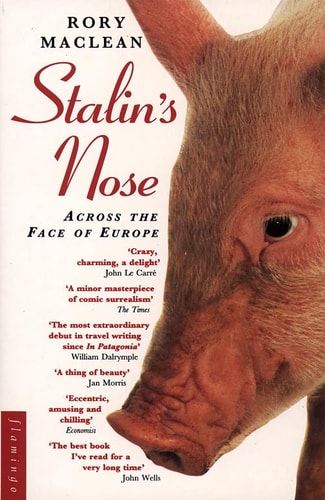
Stalin's Nose: Across the Face of Europe
0
0
As an Amazon Associate and affiliate partner, Menrva Books earns from qualifying purchases. Learn more
Author Description
Winston the pig fell into Aunt Zita's life when he dropped onto her husband's head and killed him dead. It was a distressing end to a distinguished life of spying for the U.S.S.R. After the funeral Zita, a faded Austrian aristocrat and vivacious eccentric, refuses to remain at home in East Germany. Instead she hijacks her nephew Rory and, with Winston in tow, sets out on one last ride. Austrians have extended families, their lineage is Europe's history and Zita has decided to rediscover hers. In a rattling Trabant the threesome puff and wheeze across the continent, following the threads of memory Zita's remarkable east European relations - the angel of Prague, the Hungarian grave digger who had buried Stalin's nose, a dying Romanian propagandist - help tie together the loose ends of her life. The travelers picnic at Auschwitz. They meet Lenin's embalmer. They visit the impoverished Czech town where the sewers run with jewels. Everywhere they learn what life had truly been like under totalitarian rule. They hear a torrent of life tales, some heartbreaking, some hilarious, all enriched with the joy of telling after decades of enforced silence. Humorous and black, touched with the surreal and the farcical, Stalin's Nose is a true and exceptionally vivid story of a journey from the Baltic to the Black Sea, between Berlin and Moscow, through an eastern Europe divested of fear and free to face the past.
Menrva's Summary
THE THESIS
How does the post-Soviet landscape of Eastern Europe reconcile its traumatic, totalitarian past with the sudden, chaotic freedom of the early 1990s? Rory Maclean, a travel writer and observer, utilizes the framework of a road trip to document the lived experiences of individuals across a continent in transition. Through interviews and observational reportage, the book examines the intersection of personal memory and national history in the wake of the Iron Curtain's collapse.
THE SCOPE MAP
What You Will Find
- A geographic survey spanning from the Baltic Sea to the Black Sea, covering Germany, the Czech Republic, Hungary, and Romania.
- Primary source interviews with individuals ranging from Lenin's embalmer to local grave diggers and former propagandists.
- A narrative methodology that blends travelogue with historical investigation and dark, observational humor.
- An exploration of the psychological and social remnants of totalitarian rule in the lives of ordinary citizens.
THE AUTHORITY PERSPECTIVE
This work is regarded as a distinct, picaresque approach to travel writing that prioritizes the surreal and human elements of history over dry academic analysis. The narrative's focus on the absurdities of the post-Cold War era provides a unique, albeit unconventional, lens through which to view the shifting political identity of Eastern Europe.
Page Count:
224
Publication Date:
1993-01-01
Publisher:
Flamingo
ISBN-10:
0006545173
ISBN-13:
9780006545170
Memoir
Humor
History
Travel
Eastern Europe
Writing
Writing Guides
Europe
Reference
General
Community Tags
Similar Books