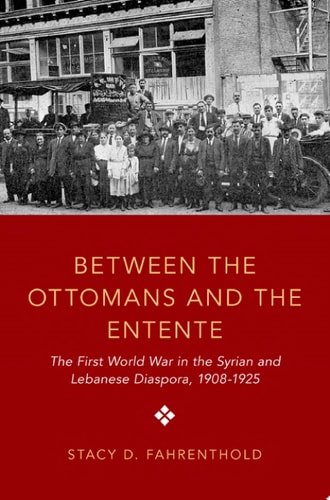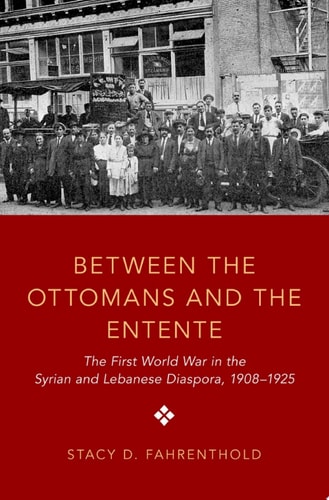
Between the Ottomans and the Entente: The First World War in the Syrian and Lebanese Diaspora, 1908-1925
0
0
As an Amazon Associate and affiliate partner, Menrva Books earns from qualifying purchases. Learn more
Author Description
Since 2011 over 5.6 million Syrians have fled to Turkey, Lebanon, Jordan, and beyond, and another 6.6 million are internally displaced. The contemporary flight of Syrian refugees comes one century after the region's formative experience with massive upheaval, displacement, and geopolitical intervention: the First World War.In this book, Stacy Fahrenthold examines the politics of Syrian and Lebanese migration around the period of the First World War. Some half million Arab migrants, nearly all still subjects of the Ottoman Empire, lived in a diaspora concentrated in Brazil, Argentina, and the United States. They faced new demands for their political loyalty from Istanbul, which commanded them to resist European colonialism. From the Western hemisphere, Syrian migrants grappled with political suspicion, travel restriction, and outward displays of support for the war against the Ottomans. From these diasporic communities, Syrians used their ethnic associations, commercial networks, and global press to oppose Ottoman rule, collaborating with the Entente powers because they believed this war work would bolster the cause of Syria's liberation. Between the Ottomans and the Entente shows how these communities in North and South America became a geopolitical frontier between the Young Turk Revolution and the early French Mandate. It examines how empires at war-from the Ottomans to the French-embraced and claimed Syrian migrants as part of the state-building process in the Middle East. In doing so, they transformed this diaspora into an epicenter for Arab nationalist politics.Drawing on transnational sources from migrant activists, this wide-ranging work reveals the degree to which Ottoman migrants "became Syrians" while abroad and brought their politics home to the post-Ottoman Middle East.
Menrva's Summary
THE THESIS
How did the Syrian and Lebanese diaspora in the Americas navigate the competing political demands of the Ottoman Empire and the Entente powers during the First World War? Stacy D. Fahrenthold, a scholar of Middle Eastern history, utilizes a transnational framework to analyze the political mobilization of Arab migrants between 1908 and 1925. By examining the activities of ethnic associations, commercial networks, and the global press, the author argues that these diasporic communities functioned as a critical geopolitical frontier. The research demonstrates how these migrants leveraged their position to influence the transition from Ottoman rule to the French Mandate, ultimately shaping the development of modern Arab nationalism.
THE SCOPE MAP
What You Will Find
- Analysis of migrant political activism in Brazil, Argentina, and the United States.
- Examination of the impact of the Young Turk Revolution on diaspora loyalty.
- Documentation of collaboration between Syrian migrants and Entente powers.
- Investigation into the role of ethnic associations and the Arabic-language press.
Scope Limits
- The study focuses primarily on the political and diplomatic dimensions of the diaspora rather than the domestic social history of the Levant itself.
- The narrative concludes in 1925, limiting the analysis of long-term post-Mandate political developments.
THE AUTHORITY PERSPECTIVE
Historians and scholars of migration studies recognize this work as a significant contribution to the understanding of transnational political networks during the early twentieth century. Experts frequently highlight the author's rigorous use of multilingual archival sources to reconstruct the influence of the diaspora on Middle Eastern state-building.
Page Count:
233
Publication Date:
2019-01-01
Publisher:
Oxford University Press
ISBN-10:
0190872152
ISBN-13:
9780190872151
History
American History
Asia history
Syria history
Middle Eastern
Migration Studies
World War
Syrians
Community Tags
Similar Books