From Psychology to Morality: Essays in Ethical Naturalism
0
0
As an Amazon Associate and affiliate partner, Menrva Books earns from qualifying purchases. Learn more
Author Description
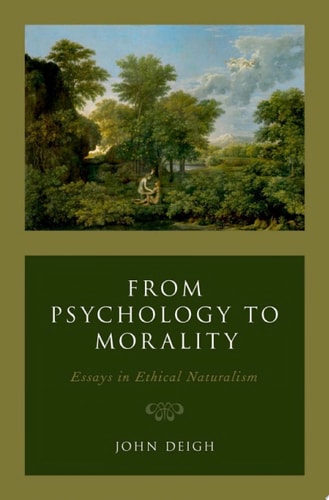
The essays in this collection belong to the tradition of naturalism in ethics. The tradition goes back to the beginnings of moral philosophy in ancient Greek thought. Its program is to explain moral thought and action as wholly natural phenomena. Its aim, in other words, is to explain such thought and action without recourse to either a reality separate from that of the natural world or volitional powers that operate independently of natural forces. Its greatest exponent in ancient thought was Aristotle. In modern thought Hume and Freud stand out as the most influential contributors to the tradition. All three thinkers made the study of human psychology fundamental to their work in ethics. All three built their theories on studies of human desires and emotions and assigned to reason the role of guiding the actions that spring from our desires and emotions toward ends that promise self-fulfillment and away from ends that are self-destructive. The collection's essays draw inspiration from their ideas. Its twelve principal essays are arranged to follow the lead of Aristotle's and Hume's ethics. The first three survey and examine general theories of emotion and motivation. The next two focus on emotions that are central to human sociability and that contemporary Anglo-American philosophers discuss under the rubric of reactive attitudes. Turning to distinctively cognitive powers necessary for moral thought and action, the sixth and seventh essays discuss the role of empathy in moral judgment and defend Bernard Williams's controversial account of practical reason. The final five essays use the studies in moral psychology of the previous chapters to treat questions in ethics and social philosophy. The treatment of these questions exemplifies the implementation of a naturalist program in these disciplines.
Menrva's Summary
THE THESIS
This collection investigates the viability of ethical naturalism by examining how moral thought and action can be explained as entirely natural phenomena without invoking supernatural or independent volitional powers. John Deigh, a scholar of moral philosophy, builds upon the historical foundations laid by Aristotle, Hume, and Freud. He argues that human psychology—specifically the interplay between desires, emotions, and reason—serves as the essential framework for understanding moral behavior and achieving self-fulfillment.
THE SCOPE MAP
What You Will Find
- Analysis of general theories regarding human emotion and motivation.
- Examination of reactive attitudes central to human sociability.
- Discussion on the role of empathy in moral judgment.
- Defense of Bernard Williams's account of practical reason.
- Application of moral psychology to broader questions in social philosophy.
Scope Limits
- The text does not address non-naturalist or transcendental ethical frameworks.
- It focuses primarily on the Anglo-American philosophical tradition rather than continental or Eastern ethical systems.
THE AUTHORITY PERSPECTIVE
Experts recognize this collection as a rigorous contribution to the naturalist tradition in ethics, particularly for its synthesis of psychological inquiry and moral theory. Readers frequently note the academic density of the prose, which is best suited for those familiar with contemporary Anglo-American philosophical discourse.
Page Count:
296
Publication Date:
2018-01-01
Publisher:
Oxford University Press
ISBN-10:
0190878614
ISBN-13:
9780190878610
Philosophy
Academic
Ethics
Naturalism
Community Tags
Similar Books