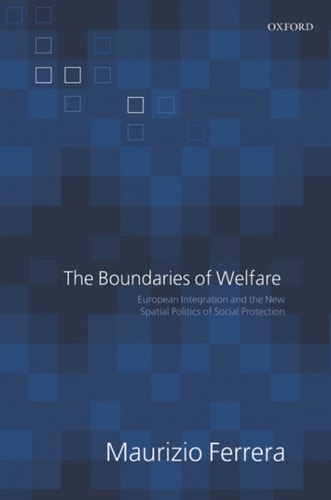
The Boundaries of Welfare: European Integration and the New Spatial Politics of Social Protection
0
0
As an Amazon Associate and affiliate partner, Menrva Books earns from qualifying purchases. Learn more
Author Description
To what extent has the process of European integration re-drawn the boundaries of national welfare states? What are the effects of such re-drawing? Boundaries count: they are essential in bringing together individuals, groups, and territorial units, and for activating or strengthening shared ties between them. If the profile of boundaries changes over time, we might expect significant consequences on bonding dynamics, i.e. on the way solidarity is structured in a given political community. The book addresses these two questions in a broad historical and comparative perspective. The first chapter sets out a novel theoretical framework which re-conceptualizes the welfare state as a 'bounded space' characterized by a distinct spatial politics. This reconceptualization takes as a starting point the 'state-building tradition' in political science and in particular the work of Stein Rokkan. The second chapter briefly outlines the early emergence and expansion of European welfare states till World War II. Chapters 3 and 4 analyse the relationship between domestic welfare state developments and the formation of a supranational European Community between the 1960s and the 2000s, illustrating how the process of European integration has increasingly eroded the social sovereignty of the nation-state. Chapter 5 focuses on new emerging forms of sub-national and trans-national social protection, while Chapter 6 discusses current trends and future perspectives for a re-structuring of social protection at the EU level. While there is no doubt that European integration has significantly altered the boundaries of national welfare, de-stabilizing delicate political and institutional equilibria, the book concludes by offering some suggestions on how a viable system of multi-level social protection could possibly emerge within the new EU wide boundary configuration.
Menrva's Summary
THE THESIS
How has the process of European integration fundamentally altered the spatial boundaries and structural integrity of national welfare states? Maurizio Ferrera, a prominent scholar in comparative social policy, utilizes a historical and institutionalist framework to examine the erosion of national social sovereignty. By applying the state-building theories of Stein Rokkan, the author argues that the shift toward supranational governance has destabilized traditional welfare equilibria and necessitates a new model of multi-level social protection.
THE SCOPE MAP
What You Will Find
- A theoretical framework conceptualizing the welfare state as a bounded space.
- Historical analysis of European welfare development from the pre-WWII era to the 2000s.
- Examination of the tension between domestic social policy and supranational EU integration.
- Discussion of emerging sub-national and trans-national social protection mechanisms.
Scope Limits
- The text does not provide a comprehensive policy manual for individual EU member states.
- It does not offer a definitive predictive model for future EU legislative outcomes.
THE AUTHORITY PERSPECTIVE
Scholars in the field of European integration frequently cite this work for its rigorous application of Rokkanian theory to contemporary social policy challenges. Readers often note the academic density of the prose, which serves as a foundational text for understanding the structural shifts in European social governance.
Page Count:
317
Publication Date:
2006-01-01
Publisher:
Oxford University Press
ISBN-10:
0191536423
ISBN-13:
9780191536427
Economics
Social policy
International relations
Public Policy
Sociology
Community Tags
Similar Books