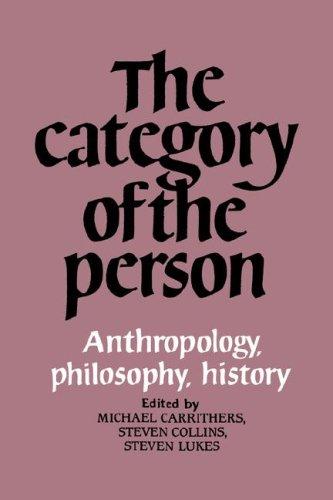
The Category of the Person
0
0
As an Amazon Associate and affiliate partner, Menrva Books earns from qualifying purchases. Learn more
Author Description
The concept that peope have of themselves as a 'person' is one of the most intimate notions that they hold. Yet the way in which the category of the person is conceived varies over time and space. In this volume, anthropologists, philosophers, and historians examine the notion of the person in different cultures, past and present. Taking as their starting point a lecture on the person as a category of the human mind, given by Marcel Mauss in 1938, the contributors critically assess Mauss's speculation that notions of the person, rather than being primarily philosophical or psychological, have a complex social and ideological origin. Discussing societies ranging from ancient Greece, India, and China to modern Africa and Papua New Guinea, they provide fascinating descriptions of how these different cultures define the person. But they also raise deeper theoretical issues: What is universally constant and what is culturally variable in people's thinking about the person? How can these variations be explained? Has there been a general progressive development toward the modern Western view of the person? What is distinctive about this? How do one's notions of the person inform one's ability to comprehend alternative formulations? These questions are of compelling interest for a wide range of anthropologists, philosophers, historians, psychologists, sociologists, orientalists, and classicists. The book will appeal to any reader concerned with understanding one of the most fundamental aspects of human existence
Menrva's Summary
THE THESIS
This volume investigates the diverse and evolving conceptions of the 'person' across various cultures and historical periods. The book, drawing from a 1938 lecture by Marcel Mauss, brings together anthropologists, philosophers, and historians to critically examine the social and ideological origins of personal identity, challenging the notion that these concepts are primarily philosophical or psychological. Contributors explore how societies from ancient Greece, India, and China to modern Africa and Papua New Guinea define the person, raising fundamental questions about universal constants versus cultural variations in human self-conception.
THE SCOPE MAP
- Exploration of the concept of the 'person' as a category of the human mind.
- Analysis of the social and ideological origins of personal identity, referencing Marcel Mauss's 1938 lecture.
- Comparative studies of the notion of the person in ancient Greece, India, and China.
- Examination of contemporary concepts of the person in Africa and Papua New Guinea.
- Discussion of universal versus culturally variable aspects of thinking about the person.
- Inquiry into the progressive development towards modern Western views of the person.
- Consideration of how one's own notions of the person affect the comprehension of alternative formulations.
THE AUTHORITY PERSPECTIVE
This collection of essays offers a deep dive into the anthropological and philosophical understanding of personhood, likely appealing to specialists in the field. The contributors' examination of diverse cultural perspectives, rooted in Mauss's foundational lecture, suggests a rigorous academic approach to the subject. The book's scope, spanning ancient to modern societies, indicates a comprehensive treatment of the topic, prompting readers to consider the constructed nature of identity.
Page Count:
309
Publication Date:
1985-01-01
ISBN-10:
0521259096
Philosophy
Non-Fiction
History
Anthropology
Community Tags
Similar Books














