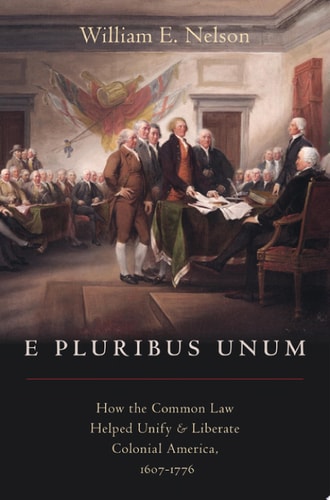
E Pluribus Unum
0
0
As an Amazon Associate and affiliate partner, Menrva Books earns from qualifying purchases. Learn more
Author Description
The Colonies That Comprised Pre-revolutionary America Had Thirteen Legal Systems And Governments. Given Their Diversity, How Did They Evolve Into A Single Nation? In E Pluribus Unum, The Eminent Legal Historian William E. Nelson Explains How This Diverse Array Of Legal Orders Gradually Converged Over Time, Laying The Groundwork For The Founding Of The United States. From Their Inception, The Colonies Exercised A Range Of Approaches To The Law. For Instance, While New England Based Its Legal System Around The Word Of God, Maryland Followed The Common Law Tradition, And New York Adhered To Dutch Law. Over Time, Though, The British Crown Standardized Legal Procedure In An Effort To More Uniformly And Efficiently Exert Control Over The Empire. But, While The Common Law Emerged As The Dominant System Across The Colonies, Its Effects Were Far From What English Rulers Had Envisioned. E Pluribus Unum Highlights The Political Context In Which The Common Law Developed And How It Influenced The United States Constitution. In Practice, The Triumph Of The Common Law Over Competing Approaches Gave Lawyers More Authority Than Governing Officials. By The End Of The Eighteenth Century, Many Colonial Legal Professionals Began To Espouse Constitutional Ideology That Would Mature Into The Doctrine Of Judicial Review. In Turn, Laypeople Came To Accept Constitutional Doctrine By The Time Of Independence In 1776. Ultimately, Nelson Shows That The Colonies' Gradual Embrace Of The Common Law Was Instrumental To The Establishment Of The United States. Not Simply A Masterful Legal History Of Colonial America, Nelson's Magnum Opus Fundamentally Reshapes Our Understanding Of The Sources Of Both The American Revolution And The Founding.
Menrva's Summary
THE THESIS
This work investigates how thirteen distinct colonial legal systems converged into a unified national framework, ultimately facilitating the creation of the United States. William E. Nelson, a prominent legal historian, utilizes extensive archival research to trace the evolution of colonial jurisprudence. He argues that the British Crown's attempts to standardize legal procedures inadvertently fostered a common law tradition that empowered legal professionals and laid the intellectual foundation for the American Constitution. By examining the shift from diverse local customs to a shared constitutional ideology, Nelson provides a framework for understanding the origins of American judicial review.
THE SCOPE MAP
What You Will Find
- Analysis of the transition from diverse colonial legal systems to a unified common law tradition.
- Examination of the political context surrounding the adoption of English common law in the American colonies.
- Discussion of the rise of constitutional ideology and the early development of judicial review.
Scope Limits
- The text focuses primarily on legal and political structures rather than social or cultural history.
- It does not provide an exhaustive biography of the individual founders or a comprehensive military history of the Revolution.
THE AUTHORITY PERSPECTIVE
Scholars and legal historians frequently cite this work as a foundational text for understanding the intersection of colonial law and the American founding. Readers often note the academic density of the prose, which is tailored for those with an interest in constitutional development and legal theory.
Page Count:
336
Publication Date:
2019-01-01
Publisher:
Oxford University Press
ISBN-10:
0190880813
ISBN-13:
9780190880811
History
American History
Constitutional Law
Legal History
Community Tags
Similar Books