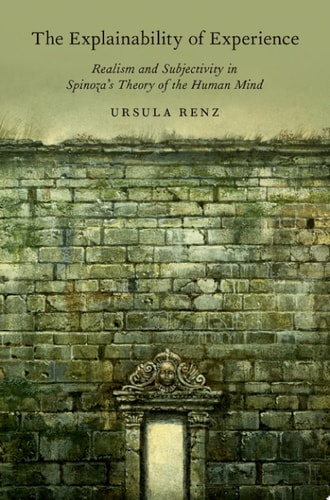
The Explainability of Experience: Realism and Subjectivity in Spinoza's Theory of the Human Mind
0
0
As an Amazon Associate and affiliate partner, Menrva Books earns from qualifying purchases. Learn more
Author Description
This book reconstructs Spinoza's theory of the human mind against the backdrop of the twofold notion that subjective experience is explainable and that its successful explanation is of ethical relevance, because it makes us wiser, freer, and happier. Doing so, the book defends a realist rationalist interpretation of Spinoza's approach which does not entail commitment to an ontological reduction of subjective experience to mere intelligibility. In contrast to a long-standing tradition of Hegelian reading of Spinoza's Ethics, it thus defends the notion that the experience of finite subjects is fully real.
Menrva's Summary
THE THESIS
This book investigates how Baruch Spinoza’s theory of the human mind reconciles the explainability of subjective experience with its inherent ethical significance. Ursula Renz, a scholar of early modern philosophy, utilizes a rigorous analytical framework to challenge traditional Hegelian interpretations of Spinoza’s Ethics. She argues for a realist rationalist perspective, positing that Spinoza’s system accounts for the reality of finite subjective experience without reducing it to mere intellectual abstraction.
THE SCOPE MAP
What You Will Find
- A detailed reconstruction of Spinoza’s theory of mind and its relation to subjective experience.
- A critical analysis of the Hegelian tradition in Spinoza scholarship.
- An examination of the ethical implications of rationalist philosophy.
Scope Limits
- The text does not provide a general introduction to Spinoza’s life or historical context.
- It does not cover the entirety of Spinoza’s political philosophy, focusing primarily on the Ethics.
THE AUTHORITY PERSPECTIVE
Scholars frequently note the technical density and philosophical precision of Renz’s prose. Experts highlight this work as a significant contribution to contemporary debates regarding realism and rationalism in early modern thought.
Page Count:
328
Publication Date:
2018-01-01
Publisher:
Oxford University Press
ISBN-10:
0190886412
ISBN-13:
9780190886417
Philosophy
Metaphysics
Subjectivity
Knowledge Theory
Experience
Rationalism
Spinoza
Epistemology
Mind & Body
History & Surveys
Philosophy of
Community Tags
Similar Books