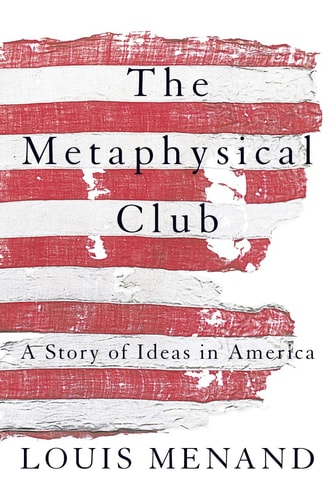
The Metaphysical Club: A Story of Ideas in America
0
0
As an Amazon Associate and affiliate partner, Menrva Books earns from qualifying purchases. Learn more
Author Description
A riveting, original book about the creation of the modern American mind. The Metaphysical Club was an informal group that met in Cambridge, Massachusetts, in 1872, to talk about ideas. Its members included Oliver Wendell Holmes, Jr., founder of modern jurisprudence; William James, the father of modern American psychology; and Charles Sanders Peirce, logician, scientist, and the founder of semiotics. The Club was probably in existence for about nine months. No records were kept. The one thing we know that came out of it was an idea -- an idea about ideas. This book is the story of that idea. Holmes, James, and Peirce all believed that ideas are not things "out there" waiting to be discovered but are tools people invent -- like knives and forks and microchips -- to make their way in the world. They thought that ideas are produced not by individuals, but by groups of individuals -- that ideas are social. They do not develop according to some inner logic of their own but are entirely dependent -- like germs -- on their human carriers and environment. And they thought that the survival of any idea depends not on its immutability but on its adaptability. 'The Metaphysical Club' is written in the spirit of this idea about ideas. It is not a history of philosophy but an absorbing narrative about personalities and social history, a story about America. It begins with the American Civil War and ends with World War I. This is a book about the evolution of the American mind during the crucial period that formed the world we now inhabit.
Menrva's Summary
THE THESIS
How did the intellectual landscape of the United States shift from the rigid certainties of the antebellum era to the pragmatic, experimental mindset of the twentieth century? Louis Menand, a professor and cultural critic, utilizes the lives and interactions of four key thinkers—Oliver Wendell Holmes, Jr., William James, Charles Sanders Peirce, and John Dewey—to map the development of American pragmatism. He argues that the trauma of the Civil War necessitated a new way of thinking, one that treated ideas as social tools for survival rather than static truths. By weaving together biography and historical context, Menand demonstrates how these figures collectively dismantled Victorian intellectual frameworks to construct the modern American consciousness.
THE SCOPE MAP
What You Will Find
- A detailed examination of the intellectual transition between the American Civil War and World War I.
- Biographical profiles of Oliver Wendell Holmes, Jr., William James, Charles Sanders Peirce, and John Dewey.
- An analysis of the origins and evolution of Pragmatism as a distinct American philosophical movement.
- Contextual history regarding the development of modern American jurisprudence, psychology, and semiotics.
THE AUTHORITY PERSPECTIVE
The subject matter points to a dense, scholarly, yet highly accessible historical narrative that bridges the gap between academic philosophy and general cultural history. The framing suggests a rigorous investigation into the social conditions that allow specific ideas to flourish, making it a standard text for understanding the roots of contemporary American thought.
Page Count:
560
Publication Date:
2001-05-01
Publisher:
Farrar, Straus and Giroux.
ISBN-10:
0007126905
ISBN-13:
9780007126903
History
Philosophy
Biography
Political
Sociology
Leaders & Notable People
American History
Intellectual History
Community Tags
Similar Books














