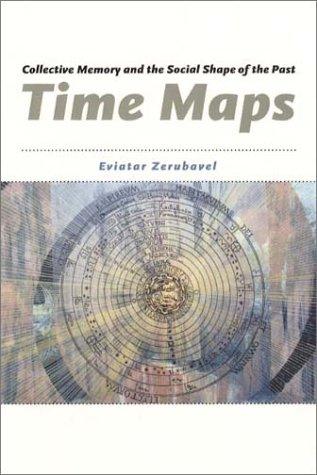
Time Maps
0
0
As an Amazon Associate and affiliate partner, Menrva Books earns from qualifying purchases. Learn more
Author Description
"Who were the first people to inhabit North America? Does the West Bank belong to the Arabs or the Jews? Why are racists so obsessed with origins? Is a seventh cousin still a cousin? Why do some societies name their children after dead ancestors?" "As Eviatar Zerubavel demonstrates in Time Maps, we cannot answer questions such as these without a deeper understanding of how we envision the past. In a pioneering attempt to map the structure of our collective memory, Zerubavel considers the cognitive patterns we use to organize the past in our minds and the mental strategies that help us string together unrelated events into coherent and meaningful narratives, as well as the social grammar of battles over conflicting interpretations of history. Drawing on fascinating examples that range from Hiroshima to the Holocaust, from Columbus to Lucy, and from ancient Egypt to the former Yugoslavia, Zerubavel shows how we construct historical origins; how we tie discontinuous events together into stories; how we link families and entire nations through genealogies; and how we separate distinct historical periods from one another through watersheds, such as the invention of fire or the fall of the Berlin Wall." "Most people think the Roman Empire ended in 476, even though it lasted another 977 years in Byzantium. Challenging such conventional wisdom, Time Maps will be must reading for anyone interested in how the history of our world takes shape."--Jacket.
Menrva's Summary
THE THESIS
This book investigates the cognitive and social mechanisms by which humans construct and organize their understanding of the past. Eviatar Zerubavel, a sociologist, examines the mental patterns and strategies people employ to create coherent historical narratives, linking disparate events and establishing collective memory. The work draws upon a wide array of historical examples, from ancient civilizations to modern conflicts, to illustrate how origins are defined, how genealogies connect individuals and nations, and how historical periods are demarcated.
THE SCOPE MAP
- Analysis of cognitive patterns used to organize collective memory.
- Exploration of mental strategies for creating coherent historical narratives.
- Examination of social grammar and conflicts over historical interpretations.
- Case studies including Hiroshima, the Holocaust, Columbus, ancient Egypt, and the former Yugoslavia.
- Discussion of how historical origins are constructed.
- Explanation of how discontinuous events are linked into stories.
- Analysis of how families and nations are linked through genealogies.
THE AUTHORITY PERSPECTIVE
The book challenges conventional understandings of historical timelines and the construction of collective memory, offering a sociological and cognitive perspective on how we perceive and narrate the past. It is noted for its pioneering attempt to map the structure of collective memory and its use of diverse historical examples to illustrate complex concepts. The work is positioned as essential reading for those interested in the formation of historical understanding and the social dynamics of interpreting history.
Page Count:
184
Publication Date:
2003-01-01
ISBN-10:
0226981525
ISBN-13:
9780226981529
Non-Fiction
History
Science
Philosophy
Sociology
Memory Studies