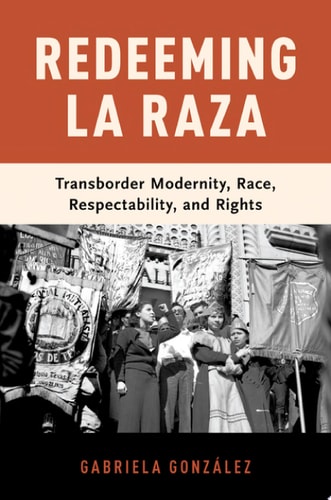
Redeeming La Raza: Transborder Modernity, Race, Respectability, and Rights
0
0
As an Amazon Associate and affiliate partner, Menrva Books earns from qualifying purchases. Learn more
Author Description
The transborder modernization of Mexico and the American Southwest during the late nineteenth and early twentieth centuries transformed the lives of ethnic Mexicans across the political divide. While industrialization, urbanization, technology, privatization, and wealth concentration benefitted some, many more experienced dislocation, exploitative work relations, and discrimination based on race, gender, and class. The Mexican Revolution brought these issues to the fore within Mexican society, igniting a diaspora to el norte. Within the United States, similar economic and social power dynamics plagued Tejanos and awaited the war refugees. Political activism spearheaded by individuals and organizations such as the Idars, Leonor Villegas' de Magnón's White Cross, the Magonista movement, the Munguias, Emma Tenayuca, and LULAC emerged in the borderlands to address the needs of ethnic Mexicans whose lives were shaped by racism, patriarchy, and poverty. As Gabriela Gonzalez shows in this book, economic modernization relied on social hierarchies that were used to justify economic inequities. Redeeming la raza was about saving ethnic Mexicans in Texas from a social hierarchy premised on false notions of white supremacy and Mexican inferiority. Activists used privileges of class, education, networks, and organizational skills to confront the many injustices that racism bred, but they used different strategies. Thus, the anarcho-syndicalist approach of Magónistas stands in contrast to the social and cultural redemption politics of the Idars who used the press to challenge a Jaime Crow world. Also, the family promoted the intellectual, material, and cultural uplift of la raza, working to combat negative stereotypes of ethnic Mexicans. Similar contrasts can be drawn between the labor activism of Emma Tenayuca and the Munguias, whose struggle for rights employed a politics of respectability that encouraged ethnic pride and unity. Finally, maternal feminist approaches and the pol
Menrva's Summary
THE THESIS
How did ethnic Mexican activists in the Texas borderlands navigate the intersection of economic modernization, systemic racism, and social hierarchy during the late nineteenth and early twentieth centuries? Historian Gabriela González examines the multifaceted political responses of Tejanos and Mexican immigrants to the exclusionary pressures of industrialization and white supremacy. By analyzing the lives and organizational efforts of figures such as the Idar family, Emma Tenayuca, and the Munguias, the author argues that these activists utilized diverse strategies—ranging from anarcho-syndicalism to the politics of respectability—to challenge the prevailing social order and advocate for the uplift of their communities.
THE SCOPE MAP
What You Will Find
- Analysis of transborder modernization in Mexico and the American Southwest.
- Comparative study of activist strategies including labor organizing, journalism, and maternal feminism.
- Examination of the impact of the Mexican Revolution on borderland social dynamics.
- Documentation of organizations such as LULAC and the Magonista movement.
Scope Limits
- The study focuses primarily on the Texas borderlands rather than the entirety of the U.S.-Mexico border.
- The analysis is constrained to the late nineteenth and early twentieth centuries.
THE AUTHORITY PERSPECTIVE
Scholars recognize this work as a significant contribution to the history of the American Southwest, particularly for its nuanced exploration of class and gender within Mexican American political movements. Readers frequently note the depth of the archival research and the clarity with which the author distinguishes between competing ideological approaches to civil rights.
Page Count:
280
Publication Date:
2018-01-01
Publisher:
Oxford University Press
ISBN-10:
0190902159
ISBN-13:
9780190902155
History
Politics & Government
American Studies
American History
Sociology
Civil Rights
Texas biography
Community Tags
Similar Books














