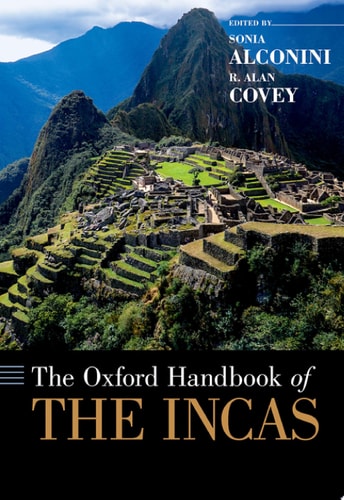
The Oxford Handbook of the Incas (Oxford Handbooks)
0
0
As an Amazon Associate and affiliate partner, Menrva Books earns from qualifying purchases. Learn more
Author Description
When Spaniards invaded their realm in 1532, the Incas ruled the largest empire of the pre-Columbian Americas. Just over a century earlier, military campaigns began to extend power across a broad swath of the Andean region, bringing local societies into new relationships with colonists and officials who represented the Inca state. With Cuzco as its capital, the Inca empire encompassed a multitude of peoples of diverse geographic origins and cultural traditions dwelling in the outlying provinces and frontier regions. Bringing together an international group of well-established scholars and emerging researchers, this handbook is dedicated to revealing the origins of this empire, as well as its evolution and aftermath. Chapters break new ground using innovative multidisciplinary research from the areas of archaeology, ethnohistory and art history.The scope of this handbook is comprehensive. It places the century of Inca imperial expansion within a broader historical and archaeological context, and then turns from Inca origins to the imperial political economy and institutions that facilitated expansion. Provincial and frontier case studies explore the negotiation and implementation of state policies and institutions, and their effects on the communities and individuals that made up the bulk of the population. Several chapters describe religious power in the Andes, as well as the special statuses that staffed the state religion, maintained records, served royal households, and produced fine craft goods to support state activities.The Incas did not disappear in 1532, and the volume continues into the Colonial and later periods, exploring not only the effects of the Spanish conquest on the lives of the indigenous populations, but also the cultural continuities and discontinuities. Moving into the present, the volume ends will an overview of the ways in which the image of the Inca and the pre-Columbian past is memorialized and reinterpreted by contemporary Andeans.
Menrva's Summary
THE THESIS
This volume investigates the origins, expansion, institutional structure, and enduring legacy of the Inca Empire through a multidisciplinary lens. Edited by R. Alan Covey and Sonia Alconini, the handbook compiles contributions from an international cohort of scholars to synthesize current research in archaeology, ethnohistory, and art history. The text provides a comprehensive framework for understanding how the Inca state managed diverse populations and how its influence persisted well beyond the Spanish conquest of 1532.
THE SCOPE MAP
What You Will Find
- Analysis of Inca imperial political economy and state institutions
- Case studies on provincial and frontier administration
- Examination of religious power and social stratification
- Research on the colonial period and contemporary cultural memory
Scope Limits
- The text does not provide a singular narrative history of individual Inca rulers
- It does not focus on popular or speculative theories regarding Inca origins
THE AUTHORITY PERSPECTIVE
Scholars and students of Andean history regard this volume as a comprehensive reference work that successfully integrates diverse academic methodologies. Readers frequently note the academic density of the prose, which serves as a rigorous resource for researchers and advanced students in the field.
Page Count:
880
Publication Date:
2018-01-01
Publisher:
Oxford University Press
ISBN-10:
0190908033
ISBN-13:
9780190908034
History
American History
Incas
Pre-Columbian History
America history
Archaeology
American Studies
Anthropology
Inca Empire
Community Tags
Similar Books