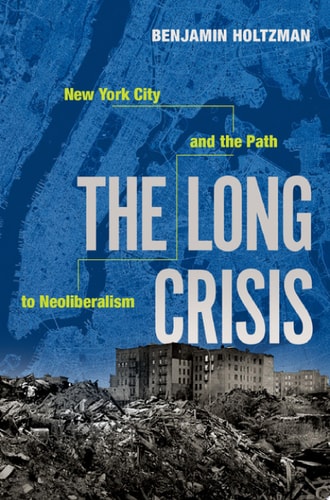
The Long Crisis: New York City and the Path to Neoliberalism
0
0
As an Amazon Associate and affiliate partner, Menrva Books earns from qualifying purchases. Learn more
Author Description
Across all the boroughs, The Long Crisis shows, New Yorkers helped transform their broke and troubled city in the 1970s by taking the responsibilities of city governance into the private sector and market, steering the process of neoliberalism. Newspaper headlines beginning in the mid-1960s blared that New York City, known as the greatest city in the world, was in trouble. They depicted a metropolis overcome by poverty and crime, substandard schools, unmanageable bureaucracy, ballooning budget deficits, deserting businesses, and a vanishing middle class. By the mid-1970s, New York faced a situation perhaps graver than the urban crisis: the city could no longer pay its bills and was tumbling toward bankruptcy.The Long Crisis turns to this turbulent period to explore the origins and implications of the diminished faith in government as capable of solving public problems. Conventional accounts of the shift toward market and private sector governing solutions have focused on the rising influence of conservatives, libertarians, and the business sector. Benjamin Holtzman, however, locates the origins of this transformation in the efforts of city dwellers to preserve liberal commitments of the postwar period. As New York faced an economic crisis that disrupted long-standing assumptions about the services city government could provide, its residents--organized within block associations, non-profits, and professional organizations--embraced an ethos of private volunteerism and, eventually, of partnership with private business in order to save their communities' streets, parks, and housing from neglect. Local liberal and Democratic officials came to see such alliances not as stopgap measures but as legitimate and ultimately permanent features of modern governance. The ascent of market-based policies was driven less by a political assault of pro-market ideologues than by ordinary New Yorkers experimenting with novel ways to maintain robust public services in the face of the ci
Menrva's Summary
THE THESIS
This book investigates how the transition toward neoliberal governance in New York City during the 1970s emerged not from top-down conservative ideology, but from the grassroots efforts of ordinary citizens attempting to preserve public services. Benjamin Holtzman, a historian, utilizes archival research and local records to challenge the conventional narrative that market-based urban governance was solely the product of libertarian or business-led political agendas. He argues that the fiscal crisis of the 1970s forced local residents and Democratic officials to adopt private volunteerism and public-private partnerships as a pragmatic response to the perceived failure of traditional municipal government.
THE SCOPE MAP
What You Will Find
- Analysis of the 1970s New York City fiscal crisis and its impact on urban policy.
- Examination of the role of block associations, non-profits, and community organizations in local governance.
- Documentation of the shift from postwar liberal commitments to market-oriented solutions.
Scope Limits
- The study focuses primarily on New York City and does not provide a comprehensive national history of neoliberalism.
- The text does not extensively cover the post-1980s evolution of these policies beyond their initial institutionalization.
THE AUTHORITY PERSPECTIVE
Historians and urban studies scholars recognize this work as a significant re-evaluation of the origins of neoliberalism at the local level. Readers frequently note the detailed archival research and the author's ability to connect grassroots community actions to broader shifts in political philosophy.
Page Count:
347
Publication Date:
2021-01-01
Publisher:
Oxford University Press
ISBN-10:
0190843721
ISBN-13:
9780190843724
History
Economics
Rural
Research Methods
History of the Americas
Urban renewal
Public Policy
Ethnic Studies
Neoliberalism
New York
Local government
Minority Studies
America history
Urban policy
Capitalism
Urban Studies
American History
Special Topics
Community Tags
Similar Books