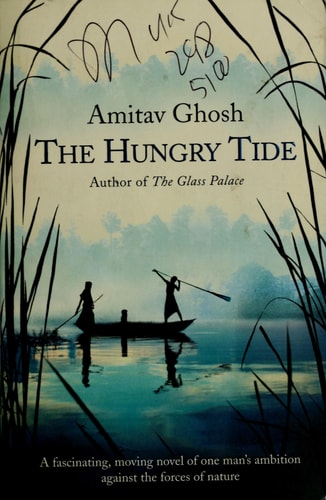
The Hungry Tide
0
0
As an Amazon Associate and affiliate partner, Menrva Books earns from qualifying purchases. Learn more
Author Description
The new novel from the author of The Glass Palace, the widely-acclaimed bestseller. The Hungry Tide is a rich, exotic saga set in Calcutta and in the vast archipelago of islands in the Bay of Bengal. An Indian myth says that when the river Ganges first descended from the heavens, the force of the cascade was so great that the earth would have been destroyed if it had not been for the god Shiva, who tamed the torrent by catching it in his dreadlocks. It is only when the Ganges approaches the Bay of Bengal that it frees itself and separates into thousands of wandering strands. The result is the Sundarbans, an immense stretch of mangrove forest, a half-drowned land where the waters of the Himalayas merge with the incoming tides of the sea. It is this vast archipelago of islands that provides the setting for Amitav Ghosh's new novel. In the Sundarbans the tides reach more than 100 miles inland and every day thousands of hectares of forest disappear only to re-emerge hours later. Dense as the mangrove forests are, from a human point of view it is only a little less barren than a desert. There is a terrible, vengeful beauty here, a place teeming with crocodiles, snakes, sharks and man-eating tigers. This is the only place on earth where man is more often prey than predator. And it is into this terrain that an eccentric, wealthy Scotsman named Daniel Hamilton tried to create a utopian society, of all races and religions, and conquer the might of the Sundarbans. In January 2001, a small ship arrives to conduct an ecological survey of this vast but little-known environment, and the scientists on board begin to trace the journeys of the descendants of this society.
Menrva's Summary
THE PULSE
A chance encounter between a marine biologist and a local fisherman in the Sundarbans archipelago triggers a search for a forgotten history buried within the shifting mangrove tides. Piya Roy, a cetologist, seeks to study the rare Irrawaddy dolphin, while Kanai Dutt, a translator, arrives to uncover his uncle's past in a failed utopian settlement. Their paths intersect in a landscape where the boundary between land and water is constantly erased by the tides. They must navigate the physical dangers of the forest—including man-eating tigers and unpredictable currents—while confronting the legacy of colonial-era social experiments and the modern pressures of ecological preservation.
INSIDE THE PAGES
- Dual narrative structure alternating between contemporary research and historical accounts
- Vivid, sensory-heavy descriptions of the Sundarbans mangrove ecosystem
- Integration of local folklore and mythology regarding the Ganges and Shiva
- Exploration of the tension between human ambition and environmental forces
- Examination of linguistic and cultural barriers between characters
- Focus on the survival of both endangered species and marginalized human communities
- Use of the tide as a recurring metaphor for memory and change
- Detailed depiction of the logistical challenges of conducting scientific research in remote terrain
THE COLLECTIVE ECHO
This novel is widely regarded for its atmospheric prose and its ability to weave complex ecological themes into a compelling human narrative. Critics often highlight the author's meticulous research and his skill in rendering the Sundarbans as a character in its own right. Readers frequently note the intellectual depth of the dialogue and the way the story balances historical inquiry with immediate, physical danger. The work is frequently cited for its success in bridging the gap between academic interest and narrative storytelling, leaving a lasting impression of the fragility of the natural world.
Page Count:
402
Publication Date:
2004-01-01
Publisher:
HarperCollins
ISBN-10:
0007141785
ISBN-13:
9780007141784
Fiction
Historical Fiction
Nature
Adventure
Fantasy
Literary Fiction
Romance
Classics
Historical
Women
Family life
Epic
India
Literary
Fiction
Action Adventure
Community Tags
Other Editions(3)


Similar Books














Reader Comments
Share Your Thoughts
No comments yet. Be the first to share your thoughts!