In Praise of Forgetting
0
0
As an Amazon Associate and affiliate partner, Menrva Books earns from qualifying purchases. Learn more
Author Description
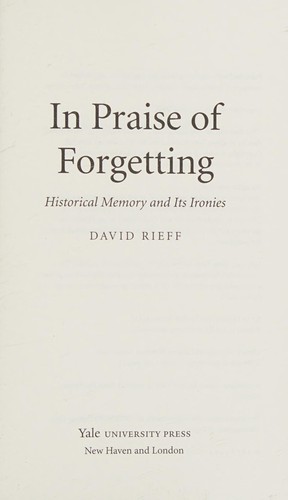
The conventional wisdom about historical memory is summed up in George Santayana’s celebrated phrase, "Those who cannot remember the past are condemned to repeat it." Today, the consensus that it is moral to remember, immoral to forget, is nearly absolute. And yet is this right? David Rieff, an independent writer who has reported on bloody conflicts in Africa, the Balkans, and Central Asia, insists that things are not so simple. He poses hard questions about whether remembrance ever truly has, or indeed ever could, "inoculate" the present against repeating the crimes of the past. He argues that rubbing raw historical wounds—whether self-inflicted or imposed by outside forces—neither remedies injustice nor confers reconciliation. If he is right, then historical memory is not a moral imperative but rather a moral option—sometimes called for, sometimes not. Collective remembrance can be toxic. Sometimes, Rieff concludes, it may be more moral to forget. Ranging widely across some of the defining conflicts of modern times—the Irish Troubles and the Easter Uprising of 1916, the white settlement of Australia, the American Civil War, the Balkan wars, the Holocaust, and 9/11—Rieff presents a pellucid examination of the uses and abuses of historical memory. His contentious, brilliant, and elegant essay is an indispensable work of moral philosophy.
Menrva's Summary
THE THESIS
The conventional wisdom that remembering the past is a moral imperative is challenged by David Rieff, who argues that forgetting can sometimes be the more ethical choice. Rieff, an experienced writer on conflict, questions whether historical memory truly prevents future atrocities. He posits that dwelling on past grievances can be detrimental, hindering justice and reconciliation rather than promoting them. His work suggests that collective remembrance is not always a virtue but a choice, and that sometimes, forgetting is the morally superior path.
THE SCOPE MAP
- An examination of the conventional wisdom surrounding historical memory and its purported benefits.
- A critical analysis of whether remembrance can truly inoculate societies against repeating past crimes.
- Exploration of how collective remembrance can be toxic and impede justice and reconciliation.
- Case studies from modern conflicts including the Irish Troubles, the Australian settlement, the American Civil War, the Balkan wars, the Holocaust, and 9/11.
- An argument for historical memory as a moral option rather than an absolute imperative.
- A philosophical inquiry into the ethics of forgetting versus remembering.
THE AUTHORITY PERSPECTIVE
David Rieff's essay is characterized as a contentious and brilliant work of moral philosophy that challenges deeply held beliefs about historical memory. The book is noted for its elegant examination of how collective remembrance can be both beneficial and detrimental, drawing on a wide range of historical conflicts. Its argument that forgetting can sometimes be the more moral option is presented as a significant and thought-provoking contribution to the discourse on history and ethics.
Page Count:
145
Publication Date:
2016-01-01
ISBN-10:
0300182791
ISBN-13:
9780300182798
History
Non-Fiction
Philosophy
Politics
Community Tags
Similar Books