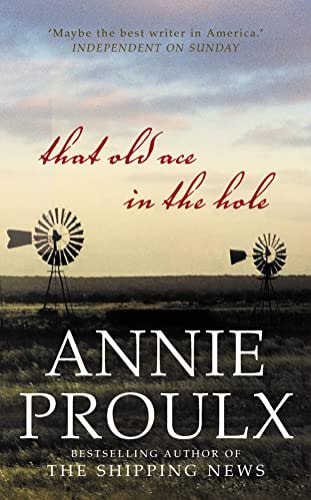
That Old Ace in the Hole
0
0
As an Amazon Associate and affiliate partner, Menrva Books earns from qualifying purchases. Learn more
Author Description
Bob Dollar is a reluctant land swindler. When the 25-year-old protagonist in Annie Proulx's That Old Ace in the Hole signs on as a location scout for Global Pork Rind, an industrial hog farming corporation, he has no idea what kind of moral quandaries he's in for. Well, maybe he does. His assignment, after all, is to infiltrate a tiny town in the Texas Panhandle and find a tract of land his employer can turn into an industrial hog farm. Bob tells the locals he's scouting for luxury home developers ("They feel there is potential here"), but as a cover story it's less than clever. Only a fool would build mansions in the godforsaken Panhandle country, a place of light soil, bad wind, killing drought, and end-of-world thunder. "To live here," one Panhandler tells Bob, "it sure helps if you are half cow and half mesquite and all crazy." The narrative follows Bob's hapless quest to ink a deal, but Proulx's mission is bigger than that. She's out to tell the story of the Panhandle itself, to write an entirely new literary territory into existence. With the help of a menagerie of eccentric characters set down in "the most complicated part of North America," Proulx succeeds admirably. --Claire Dederer
Menrva's Summary
THE PULSE
Bob Dollar, a young man tasked with scouting land for an industrial hog farm, finds his professional mission complicated by the harsh realities and eccentric inhabitants of the Texas Panhandle. As he attempts to maintain his cover story while navigating the moral implications of his employer's expansion, Bob encounters a landscape defined by extreme weather and deep-seated local traditions. The narrative, presented through a third-person perspective, tracks his interactions with the residents of this isolated region as he struggles to reconcile his corporate objectives with the human cost of his work. The story functions as both a character study and a portrait of a specific, rugged environment.
INSIDE THE PAGES
- Detailed descriptions of the Texas Panhandle landscape and climate
- A cast of eccentric, regionally specific characters
- Satirical commentary on corporate expansion and industrial farming
- Exploration of the conflict between urban interests and rural values
- Use of local dialect and regional vernacular
- Focus on the history and cultural identity of the American West
- Episodic narrative structure centered on Bob's land-scouting mission
- Themes of moral ambiguity and personal growth
THE COLLECTIVE ECHO
This work is characterized by its meticulous attention to the specific geography and cultural nuances of the Texas Panhandle. The narrative style emphasizes the interplay between the protagonist's internal moral conflict and the external pressures of the environment he inhabits. Readers often note the author's ability to render the landscape as a central, active participant in the story rather than a mere backdrop. The prose suggests a focus on the tension between modern industrialization and the preservation of traditional, albeit rugged, ways of life.
Page Count:
384
Publication Date:
2002-11-05
Publisher:
Fourth Estate
ISBN-10:
0007161824
ISBN-13:
9780007161829
Fiction
Contemporary
Satire
Contemporary
Literary
Modern fiction
Literature & Fiction
Oklahoma fiction
Regional
Texas
Fiction
Denver colo fiction
Community Tags
Other Editions(8)



Similar Books






Reader Comments
Share Your Thoughts
No comments yet. Be the first to share your thoughts!