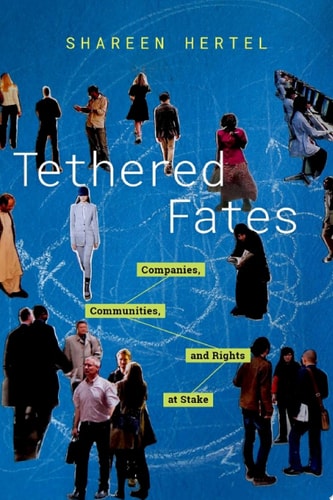
Tethered Fates: Companies, Communities, and Rights at Stake
0
0
As an Amazon Associate and affiliate partner, Menrva Books earns from qualifying purchases. Learn more
Author Description
Since the 1990s, human rights advocates, business leaders, and consumers have become increasingly attuned to mitigating sweatshop labor and other abuses in the supply chains that manufacture the clothing, electronics, and countless other products that we buy and use each day. But we know surprisingly little about how companies interact with people in the communities beyond the factory's walls. In many cases, community members are left out of the process of identifying both risks and solutions to problems in global supply chains, including how global companies could add social value in the localities where they operate. Business, governments, and civil society are supposed to be jointly responsible for shaping the remedies available to people harmed in the course of business activity, wherever it takes place. However, the answer to the question of how to do this remains underdeveloped and poorly executed. This book explores the conditions under which local communities and companies can work with one another and the types of remedies available in one of the most widespread and challenging sectors: light manufacturing. Tethered Fates draws on quantitative data (including the 7,000-company database of the Business and Human Rights Resource Centre) and original qualitative data to analyze regional and industry-specific trends in stakeholder dialogue globally and at the local level. The book features original interviews with community members in two factory towns in the Dominican Republic, whose perspectives shed light on the prospects for dialogue with companies and the challenges of everyday life in towns where light manufacturing takes place. Tethered Fates does more than simply explain why stakeholder dialogue often falls short as a vehicle for safeguarding economic rights and promoting community development. It also offers an assessment of the varieties of emerging policy alternatives for moving beyond the current state of practice.
Menrva's Summary
THE THESIS
This book investigates the mechanisms and efficacy of stakeholder dialogue between global corporations and local communities within the light manufacturing sector. Author Shareen Hertel, a scholar of human rights and international relations, utilizes a mixed-methods approach to examine why current corporate social responsibility frameworks often fail to protect economic rights. By synthesizing large-scale quantitative data with localized qualitative interviews, the text argues that current remediation strategies are underdeveloped and proposes new policy alternatives to bridge the gap between corporate operations and community welfare.
THE SCOPE MAP
What You Will Find
- Quantitative analysis of a 7,000-company database from the Business and Human Rights Resource Centre.
- Qualitative case studies based on original interviews with residents in Dominican Republic factory towns.
- A comparative framework for evaluating stakeholder dialogue across different regions and industries.
- Assessment of emerging policy alternatives for corporate accountability.
Scope Limits
- The analysis is primarily focused on the light manufacturing sector and may not be fully applicable to extractive industries or service-based supply chains.
- The book does not provide a universal legal manual for corporate litigation but rather focuses on systemic policy and dialogue structures.
THE AUTHORITY PERSPECTIVE
Experts recognize this work as a significant contribution to the study of corporate social responsibility and the practical limitations of supply chain governance. Readers frequently note the academic rigor of the text, which balances broad statistical trends with the nuanced, lived experiences of community members in manufacturing hubs.
Page Count:
237
Publication Date:
2019-01-01
Publisher:
Oxford University Press
ISBN-10:
0190903864
ISBN-13:
9780190903862
Economics
Business
Globalization
Business Ethics
Professional Career & Trade
Public Policy
Manufactures
Human rights
Community Tags
Similar Books