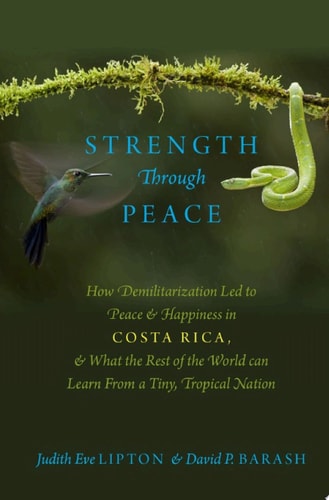
Strength Through Peace: How Demilitarization Led to Peace and Happiness in Costa Rica, and What the Rest of the World Can Learn From a Tiny, Tropical Nation
0
0
As an Amazon Associate and affiliate partner, Menrva Books earns from qualifying purchases. Learn more
Author Description
Costa Rica is the only full-fledged and totally independent country to be entirely demilitarized. Its military was abolished in 1948, with the keys to the armory handed to the Department of Education. Socially, Costa Rica is a success story. Although 94th in the world for GDP, it is in the top 10 on various measurements of health and well-being. Citizens enjoy high standards of living that include universal access to healthcare, education, and pensions. In addition, the country practices sustainable resource management, such as reforestation and the development of solar and wind power, and it expects to be carbon neutral by 2020. Hunting is illegal. 25% of the landmass is parks and reserves. The government supports universal health care, especially maternal and child health. Costa Rica even has a Blue Zone, an area where people live extraordinarily long, healthy lives. To some extent, Costa Rica is simply lucky: it was largely inaccessible, and it had virtually no precious minerals, therefore it was mostly spared the ravages of predatory colonialism. The Costa Rican people made very good social decisions, ranging from an avowed commitment to social democracy at the national level, to local land distribution to develop stable middle class farmers. But Costa Rica's neighbors have not enjoyed nearly as much peace and prosperity. It is unlikely that Costa Rica's demilitarization and its remarkable social success are coincidental; clearly, something special is going on. Through good luck, good leadership, and good decisions, Costa Rica has become arguably the sanest and most progressive country on earth. This book examines how and why Costa Rica is safe and independent without any military at all, and what the rest of us can learn from its success.
Menrva's Summary
THE THESIS
This book investigates the causal relationship between Costa Rica's 1948 decision to abolish its military and the nation's subsequent achievements in social welfare, environmental sustainability, and public health. Authors David P. Barash and Judith Eve Lipton, both established scholars in psychology and biology, utilize historical analysis and socioeconomic data to argue that demilitarization serves as a viable model for national prosperity. They posit that by reallocating military expenditures toward education and healthcare, Costa Rica has successfully fostered a stable, progressive society that challenges conventional geopolitical assumptions about national security.
THE SCOPE MAP
What You Will Find
- Historical analysis of the 1948 abolition of the Costa Rican military.
- Comparative socioeconomic data linking demilitarization to high standards of living.
- Examination of environmental policies, including reforestation and carbon neutrality goals.
- Case studies on universal healthcare and social democracy.
Scope Limits
- The text does not provide a comprehensive military history of Central America.
- It does not offer a detailed technical manual for implementing demilitarization in nations with different geopolitical constraints.
THE AUTHORITY PERSPECTIVE
Experts and readers frequently note that the authors provide a compelling, well-researched argument for the benefits of non-militarized governance. The text is widely regarded as a clear and accessible introduction to the Costa Rican model for those interested in peace studies and social policy.
Page Count:
272
Publication Date:
2018-01-01
Publisher:
Oxford University Press
ISBN-10:
0190908734
ISBN-13:
9780190908737
History
American History
Quality of Life
National security
International relations
Costa Rica
Sociology
Peace studies
Community Tags
Similar Books