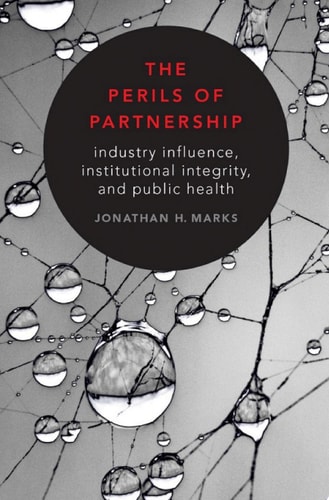
The Perils of Partnership: Industry Influence, Institutional Integrity, and Public Health
0
0
As an Amazon Associate and affiliate partner, Menrva Books earns from qualifying purchases. Learn more
Author Description
Countless public health agencies are trying to solve our most intractable public health problems -- among them, the obesity and opioid epidemics -- by partnering with corporations responsible for creating or exacerbating those problems. We are told industry must be part of the solution. But is it time to challenge the partnership paradigm and the popular narratives that sustain it? In The Perils of Partnership, Jonathan H. Marks argues that public-private partnerships and multi-stakeholder initiatives create "webs of influence" that undermine the integrity of public health agencies; distort public health research and policy; and reinforce the framing of public health problems and their solutions in ways that are least threatening to the commercial interests of corporate "partners". We should expect multinational corporations to develop strategies of influence -- but public bodies can and should develop counter-strategies to insulate themselves from corporate influence in all its forms. Marks reviews the norms that regulate public-public interactions (separation of powers) and private-private interactions (antitrust and competition law), and argues for an analogous set of norms to govern public-private interactions. He also offers a novel framework to help public bodies identify the systemic ethical implications of their current or proposed relationships with industry actors. Marks makes a compelling case that the default public-private interaction should be at arm's length: separation, not collaboration. He calls for a new paradigm that avoids the perils of corporate influence and more effectively protects and promotes public health. The Perils of Partnership is essential reading for public health officials and policymakers -- but anyone interested in public health will recognize the urgency of this book.
Menrva's Summary
THE THESIS
This book investigates whether public-private partnerships in the health sector inherently compromise institutional integrity and public welfare. Jonathan H. Marks, a scholar specializing in bioethics and global health, utilizes a framework of institutional analysis to examine how corporate influence distorts research and policy. He argues that the current reliance on industry collaboration is fundamentally flawed and proposes a shift toward arm's length interactions to protect public health interests.
THE SCOPE MAP
What You Will Find
- An analysis of the 'webs of influence' created by multi-stakeholder initiatives.
- A comparative review of norms governing public-public and private-private interactions.
- A novel ethical framework for evaluating the systemic implications of industry relationships.
Scope Limits
- The text does not provide a comprehensive history of every specific public-private partnership in existence.
- It does not offer a detailed operational manual for the day-to-day management of non-profit organizations.
THE AUTHORITY PERSPECTIVE
Experts in public health policy recognize this work as a significant critique of contemporary institutional practices. Readers frequently note the academic rigor and the clear, logical structure of the author's argument regarding corporate influence.
Page Count:
256
Publication Date:
2019-01-01
Publisher:
Oxford University Press
ISBN-10:
019090710X
ISBN-13:
9780190907105
Philosophy
Ethics
Corporate governance
Private Sector
Public Policy
Public Health
Sociology
United States
Community Tags
Similar Books