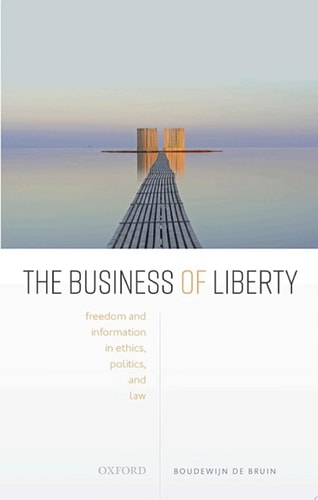
The Business of Liberty: Freedom and Information in Ethics, Politics, and Law
0
0
As an Amazon Associate and affiliate partner, Menrva Books earns from qualifying purchases. Learn more
Author Description
What makes political freedom valuable to us? Two well-known arguments are that freedom contributes to our desire satisfaction and to our personal responsibility. Here, Boudewijn de Bruin argues that freedom is valuable when it is accompanied by knowledge. He offers an original and systematic account of the relationship between freedom and knowledge and defends two original normative ideals of known freedom and acknowledged freedom. By combining psychological perspectives on choice and philosophical views on the value of knowledge, he shows how known freedom is crucial to satisfy our desires and assume responsibility. Known freedom is compromised when salespeople deploy consumer-obfuscation, or when news outlets use contextual framing techniques to steer the way their audiences process information. Conversely, carefully developed consumer protection and information disclosure regulation can foster known freedom. Acknowledged freedom, from ethical and economic perspectives, offers protection and makes our freedoms more stable. It embodies an ideal of mutual recognition that underlies informed consent and the ethics of communication, and can also contribute to a flourishing corporate culture. This book integrates and extends cutting-edge research from philosophy, economics, psychology, and law to reorient debates on privacy, neuromarketing, sustainable finance, corporate culture, consumer protection, media violence, and freedom of speech.
Menrva's Summary
THE THESIS
This book investigates the fundamental relationship between political freedom and the necessity of knowledge, arguing that freedom only maintains its value when individuals are adequately informed. Boudewijn de Bruin, a scholar in ethics and political philosophy, synthesizes insights from psychology, economics, and legal theory to construct a normative framework. He introduces the concepts of 'known freedom' and 'acknowledged freedom' to explain how information processing impacts personal responsibility and desire satisfaction. The text evaluates how modern information environments, including corporate practices and media framing, either facilitate or undermine these ideals.
THE SCOPE MAP
What You Will Find
- Normative ideals of known and acknowledged freedom
- Analysis of consumer obfuscation and media framing techniques
- Integration of psychological choice theory with philosophical ethics
- Applications in privacy, neuromarketing, and sustainable finance
Scope Limits
- Does not provide a comprehensive history of political liberty
- Does not offer specific legislative drafts for information regulation
THE AUTHORITY PERSPECTIVE
Scholars and practitioners in the fields of ethics and law recognize this work as a rigorous interdisciplinary attempt to bridge the gap between abstract political theory and practical information policy. Readers frequently note the academic density of the prose, which is best suited for those familiar with philosophical argumentation and economic theory.
Page Count:
331
Publication Date:
2022-01-01
Publisher:
OUP Oxford
ISBN-10:
0192576046
ISBN-13:
9780192576040
Psychology
Economics
Corporate governance
Law
Business Ethics
Political Philosophy
Consumer protection
Ethics
Community Tags
Similar Books