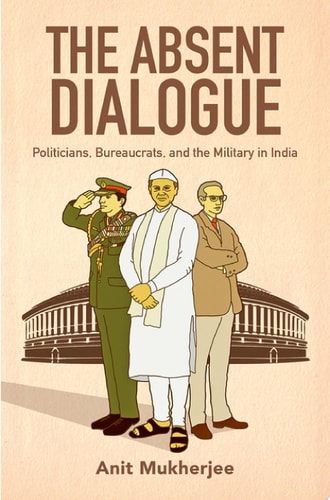
The Absent Dialogue: Politicians, Bureaucrats, and the Military in India
0
0
As an Amazon Associate and affiliate partner, Menrva Books earns from qualifying purchases. Learn more
Author Description
Civilian control over the military is widely hailed as one of the major successes of India's democracy. Because it is so rare, especially among post-colonial states, this control is rightfully celebrated. But has this come at a cost? In The Absent Dialogue, Anit Mukherjee argues that the pattern of civil-military relations in India has hampered its military effectiveness. Diving deep into understanding the organization and internal processes within the Indian military, he explains how Indian politicians and bureaucrats have long been content with the formal and ritualistic exercise of civilian control, while the military continues to operate in institutional silos. Yet, there has been little substantive engagement between the two. To support this claim, Mukherjee closely examines the variables most closely associated with military effectiveness-weapons procurement, jointness (the ability of separate military services to operate together), officer education, promotion policies, and defense planning. Further, Mukherjee shows how India's pattern of civil-military relations-best characterized as an absent dialogue-adversely affects each of these processes. While the book focuses on India, it also highlights the importance of civilian expertise and institutional design in enhancing civilian control and military effectiveness in other democracies. Informed by more than a hundred and fifty interviews and recently available archival material, The Absent Dialogue sheds new light on India's military and will reshape our understanding of both the history and contemporary dynamics of civil-military relations and recurring problems therein.
Menrva's Summary
THE THESIS
Does the established pattern of civilian control over the military in India inadvertently compromise the nation's overall military effectiveness? Anit Mukherjee, a scholar specializing in civil-military relations, investigates the institutional disconnect between India's political leadership, bureaucratic apparatus, and military forces. By analyzing internal organizational processes and historical decision-making, the author argues that a lack of substantive engagement—an 'absent dialogue'—has hindered the development of a cohesive and efficient defense strategy.
THE SCOPE MAP
What You Will Find
- Analysis of weapons procurement and defense planning processes.
- Examination of jointness and inter-service operational capabilities.
- Evaluation of officer education and promotion policy frameworks.
- Synthesis of over 150 interviews with key stakeholders.
- Integration of recently declassified archival materials.
Scope Limits
- The analysis is primarily restricted to the Indian context, though it offers broader implications for democratic civil-military relations.
- The text focuses on institutional and structural dynamics rather than tactical battlefield accounts.
THE AUTHORITY PERSPECTIVE
Experts recognize this work as a significant contribution to the study of Indian defense policy and institutional governance. Readers frequently note the academic rigor and the depth of primary source research, which provides a clear framework for understanding the complexities of civil-military relations in post-colonial democracies.
Page Count:
336
Publication Date:
2019-01-01
Publisher:
Oxford University Press
ISBN-10:
0190905921
ISBN-13:
9780190905927
Public Policy
International relations
Government
Technology & Engineering
Asian Studies
Trades & Technology
Military History
Comparative Politics
Community Tags
Other Editions(2)
Similar Books