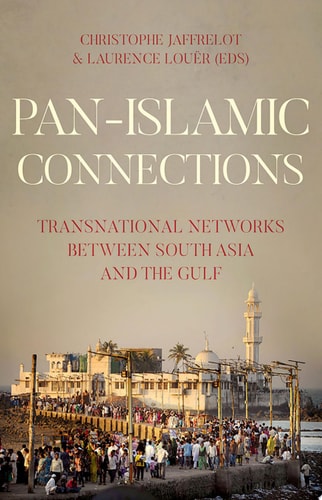
Pan-Islamic Connections: Transnational Networks Between South Asia and the Gulf
0
0
As an Amazon Associate and affiliate partner, Menrva Books earns from qualifying purchases. Learn more
Author Description
South Asia is today the region inhabited by the largest number of Muslims---roughly 500 million. In the course of the Islamisation process, which begaun in the eighth century, it developed a distinct Indo-Islamic civilisation that culminated in the Mughal Empire. While paying lip service to the power centres of Islam in the Gulf, including Mecca and Medina, this civilisation has cultivated its own variety of Islam, based on Sufism.Over the last fifty years, pan-Islamic ties have intensified between these two regions. Gathering together some of the best specialists on the subject, this volume explores these ideological, educational and spiritual networks, which have gained momentum due to political strategies, migration flows and increased communications.At stake are both the resilience of the civilisation that imbued South Asia with a specific identity, and the relations between Sunnis and Shias in a region where Saudi Arabia and Iran are fighting a cultural proxy war, as evident in the foreign ramifications of sectarianism in Pakistan. Pan-Islamic Connections investigates the nature and implications of the cultural, spiritual and socio-economic rapprochement between these two Islams.
Menrva's Summary
THE THESIS
This volume investigates the intensifying ideological, educational, and spiritual networks connecting South Asian Muslim communities with the Gulf region over the last fifty years. Edited by Christophe Jaffrelot and Laurence Louer, the work compiles research from specialists to analyze how migration, political strategy, and communication technologies have altered the traditional Indo-Islamic identity. The authors argue that these connections are reshaping regional sectarian dynamics, particularly in the context of the cultural proxy war between Saudi Arabia and Iran.
THE SCOPE MAP
What You Will Find
- Analysis of ideological and spiritual exchange between South Asia and the Gulf.
- Examination of the impact of migration flows on religious practice.
- Case studies on the foreign ramifications of sectarianism in Pakistan.
- Discussion of the tension between indigenous Sufi-based traditions and Gulf-centered Islamic movements.
Scope Limits
- The text does not provide a comprehensive history of the Mughal Empire or early Islamic expansion.
- It does not offer policy prescriptions for regional diplomatic resolution.
THE AUTHORITY PERSPECTIVE
Experts identify this collection as a significant contribution to the study of transnational religious networks and their geopolitical consequences. Scholars frequently note the academic rigor of the contributors and the clarity with which they map complex sectarian interactions.
Page Count:
322
Publication Date:
2018-01-01
Publisher:
Oxford University Press
ISBN-10:
0190911603
ISBN-13:
9780190911607
Religion
Sociology
Asian Studies
Islam
International relations
Middle Eastern
Islamic Studies